
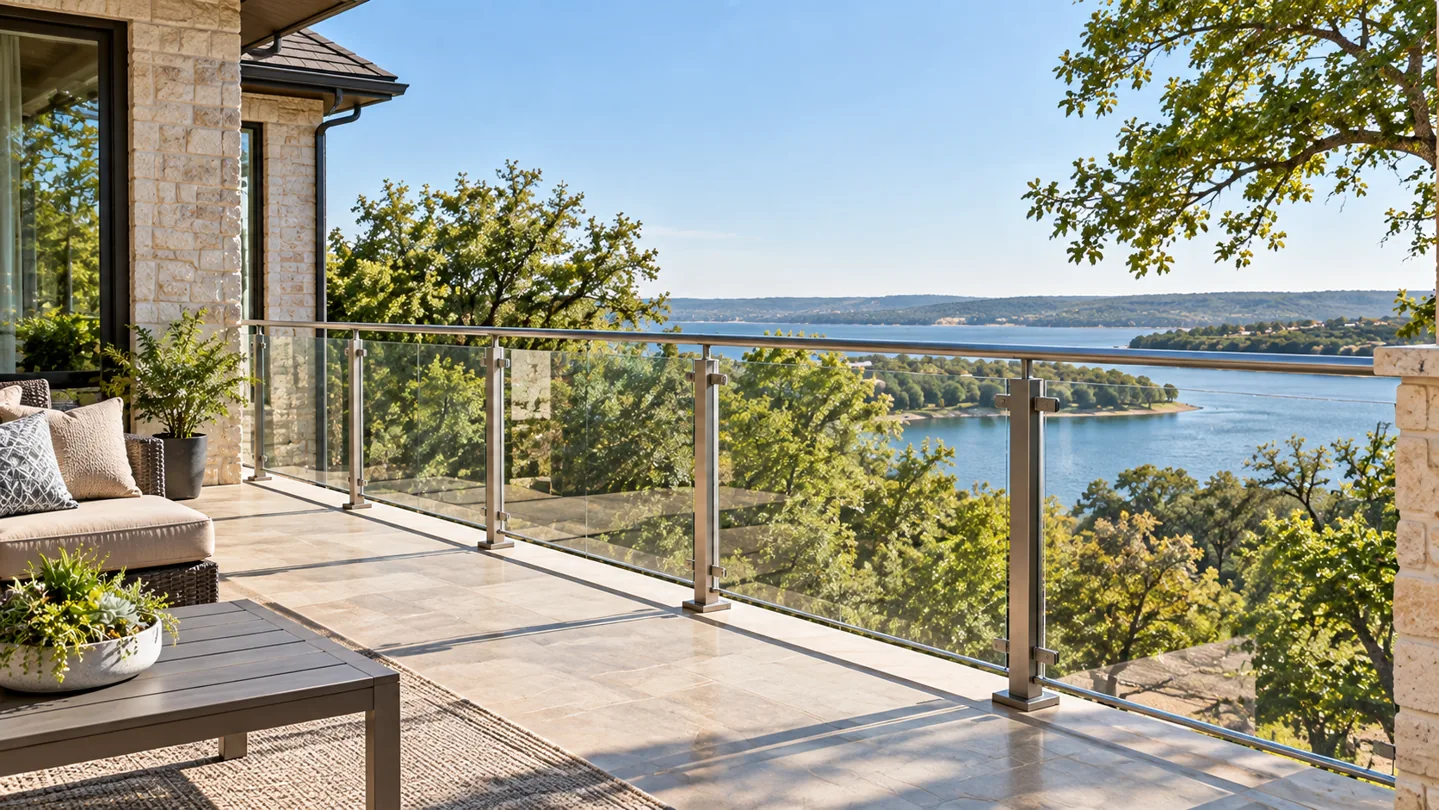
A deck in Tow looks out over some of the best water in the Hill Country, and the last thing anyone wants is a rail that blocks the view of Lake Buchanan. That is why glass railings keep coming up in conversations with homeowners here. The appeal is obvious: an unbroken sightline from a kitchen window or a screened porch straight down to the shoreline, with a properly specified glass guard between the deck and the drop. The questions that follow are less obvious. What kind of glass belongs on an exposed lakeside deck, how does it attach to a wood or stone structure, how much wind can it take out over open water, and how bad is the hard-water spotting really going to be. October is a good month to sort all of that out, while daytime temperatures are pleasant and outdoor work is comfortable. Below are the questions to discuss before selecting a residential glass guard.
Why Lake-View Decks in Tow Are Hard on Glass
Tow sits on the northern side of Lake Buchanan, and the properties that draw people here tend to be the ones with the most exposure. Open water to the west, granite and limestone underfoot, cedar and mesquite scrub that does very little to slow the wind, and seasonal heat exposure. Glass handles all of that better than most materials. It does not rot like a wood baluster, it does not rust like painted steel, and it does not chalk and fade the way some coated composites do after a decade of Central Texas ultraviolet exposure.
What glass does have to contend with is different. It has to be strong enough to be a barrier, not just a screen. It has to be held by hardware that can survive humidity coming off the lake without seizing. It has to be mounted to a substrate that will not move seasonally in a way that puts a point load on a panel. And it has to be cleanable, because the same lake breeze that makes the deck pleasant carries mineral-heavy mist, blowing dust off county roads, and pollen in the spring.
None of those are reasons to avoid a glass railing. They are reasons to specify one properly the first time. The difference between a railing that still looks sharp in year twelve and one that is cloudy and rattling in year three is almost entirely in the glass type, the hardware, and the anchoring.
Tempered and Laminated Glass: What Actually Goes on a Railing
Two words come up constantly in railing conversations, and they are not interchangeable.
Tempered glass is heat-treated after it is cut, which puts the outer surfaces in compression and the core in tension. That treatment makes it several times stronger than ordinary annealed glass of the same thickness, and it changes how it fails. Instead of breaking into long knife-edged shards, tempered glass fractures into a large number of small, comparatively dull pieces. That is a real safety improvement, and it is why tempered glass is the baseline expectation for railings, shower enclosures, and glass in and around doors.
Laminated glass is different. It is two or more plies of glass permanently bonded to an interlayer. When laminated glass is broken, the interlayer holds the fragments in place. The panel is compromised; any post-breakage barrier capacity depends on the interlayer, support and tested assembly. Isolate a damaged guard and arrange professional assessment rather than continuing to rely on it.
For a residential railing, the two are often combined: laminated panels made from tempered plies. You get the fracture behavior of tempered glass plus the post-breakage retention of a laminate. On an elevated deck where a panel is doing real barrier duty above a drop to rock or water, that retention matters. Do not select monolithic tempered glass merely because a deck appears low: the adopted code, guard function, support system and tested design determine what is permitted.
| Glass type | How it behaves if broken | Typical residential railing use |
|---|---|---|
| Annealed | Large, sharp shards | Not appropriate for railings |
| Monolithic tempered | Fragments can fall away, leaving an opening | Only where the applicable requirements and approved system permit |
| Laminated (tempered plies) | Interlayer retains fragments; assembly still requires assessment | Guard systems meeting the applicable design and retention requirements |
| Heat-strengthened laminated | Larger fragments, strongly retained | Specified where retention is prioritized |
Thickness is the other variable, driven by panel size, how the glass is supported, and the loads it carries. A tall panel held only at the bottom edge needs to be substantially thicker than a shorter panel captured on multiple sides in a frame. We size glass to the opening and the system, and we use name-brand parts and quality glass rather than budget imports, because railing hardware is the part nobody looks at until it fails.
Post, Spigot, and Channel Systems Compared
There are three common ways to hold a glass railing panel, and choosing among them is mostly an argument between how much metal you want to see and how much structure you have to work with.
Post systems
Vertical posts at intervals, with glass captured between them by clamps or a top and bottom rail. This is the most forgiving system. Glass and posts work as a specified assembly; panel thickness and anchor loads depend on the particular design rather than a universal ranking. It is also the most tolerant of a deck frame that is not perfectly flat or plumb. The tradeoff is visual: you see the posts.
Frameless spigot systems
Short, stout base fittings, usually stainless, bolted through the deck surface or the fascia, each gripping the bottom edge of a panel. Visually this is the winner. From inside the house you see glass and water and very little else. In exchange, spigots concentrate all of the load into a few anchor points, so the substrate has to be genuinely capable of taking it, and the glass has to be thicker because it is cantilevered from the bottom edge only.
Base channel systems
A continuous aluminum or stainless channel runs along the deck edge and the glass is set into it with structural gaskets or dry-glaze wedges. Load is distributed along the whole run rather than at points, alignment is easier to dial in, and the finished look is nearly as clean as spigots. Channel systems generally need a solid, level mounting surface and careful attention to drainage so water is not sitting in the channel.
| System | Visual openness | Substrate demand | Alignment tolerance |
|---|---|---|---|
| Posts with clamps | Moderate | Depends on the approved assembly | Product-specific |
| Frameless spigots | High | Concentrated loads at designed anchor points | Product-specific |
| Base channel | High | High, distributed | Moderate |
A top cap rail is a separate decision. Capping the top edge of a frameless run stiffens the panels, ties them together, and gives people something to rest a hand on. Leaving it off is the purest look. Neither appearance alone nor panel height decides whether a top rail can be omitted; the adopted requirements and approved assembly must permit the selected design.
Code and Height Considerations in Tow, in General Terms
Railings are life-safety elements, so they are governed by building code. Guards on elevated walking surfaces have to reach a minimum height, resist a specified load applied along the top and across the surface, and keep openings small enough that a child cannot pass through. Glass used in a guard has to be a safety glazing type, and where a panel is doing structural barrier work there are additional expectations about post-breakage behavior.
We deliberately do not quote section numbers or dimensions in an article, because the requirements that apply to a specific deck depend on the jurisdiction, the adopted code edition, the height above grade, and the design of the structure. What we do is measure the deck, look at how it is framed, and specify a glass type, thickness, and mounting system appropriate to the conditions. If your project involves a permit or an inspection, that is a conversation to have before glass is ordered, not after.
The practical takeaway for a homeowner: if a quote does not address glass type, thickness, and how the panels are anchored, it is not a complete quote. Those three things are the railing.
Wind Loading Over Open Water
A railing on a sheltered courtyard and a railing on a deck facing two miles of open lake are not the same engineering problem. Wind coming off water arrives with very little to slow it, and a run of glass panels is a solid surface, not a permeable one like a picket rail. That wind pressure has to go somewhere, and where it goes is into the glass, then the hardware, then the deck frame.
That reality shows up in three specification choices. The specified assembly must be evaluated for the actual exposure and design loads. Changing glass thickness or adding anchors is not a substitute for a compatible, tested system and suitable structural support. And the deck structure itself gets a hard look, because the strongest railing in the world is only as good as the blocking and fasteners underneath it.
A frameless railing also does something homeowners on the lake like: it acts as a windbreak while staying invisible. Sitting behind a glass panel on a breezy March afternoon is more pleasant than sitting behind an open picket rail, as long as the assembly was designed to take the load it is now blocking.
Hard Water, Cleaning, and Keeping the View Clear
Hill Country water is hard, and hard water is the single most common complaint about any glass in this region, railings and shower enclosures alike. When mineral-heavy water dries on glass, it leaves calcium and magnesium deposits behind. Left alone through enough cycles of sprinkler overspray, lake mist, and rain, those deposits etch into the glass surface and stop being a cleaning problem and start being a permanent one.
Three habits prevent nearly all of it:
- Keep irrigation off the glass. A single misaimed sprinkler head does more damage to a railing than a year of weather.
- Rinse and squeegee after anything leaves the glass wet and dirty. Water that dries on glass is what deposits minerals; water that is wiped off does not.
- Clean with a glass-appropriate cleaner and a soft cloth or squeegee. Skip abrasive pads and gritty powders, which scratch the surface and give future deposits something to grab.
Protective coatings applied to glass reduce how readily deposits bond and make routine cleaning easier. They are not permanent and they are not a substitute for rinsing, but on lake-facing glass they earn their keep. Suitable care also matters for custom frameless shower doors sounds nearly identical.
Hardware needs occasional attention too. Mineral film and grit build up on stainless fittings, and grit under a clamp gasket is how a panel starts to shift. A yearly look at clamp bolts, channel gaskets, and cap rail joints catches loose fittings long before anything rattles.
Beyond Railings: Custom Residential Glass Around the House
Railings are the headline, but they are one line item under residential glass, and the live site also lists window glass, mirrors, tabletops, cabinet inserts and custom glass panels. Confirm which items can be included in a particular proposal.
- Mirrors cut to size for bathrooms, entries, and closet walls, including shapes that follow a tiled niche or a sloped ceiling.
- Glass tabletops for outdoor furniture and dining tables, with polished or beveled edges and radiused corners.
- Specialty panels for other residential applications can be discussed, but the site does not explicitly confirm shelving installation. Ask about the intended support and use before assuming it is offered.
- Cabinet inserts, with available finish, thickness and support confirmed for the actual opening.
- Window glass repair, including single panes and failed insulated units where moisture has fogged the space between the panes.
- Other specialty panels need confirmation of use and support; do not assume interior partitions are offered.
Our residential glass and window services cover all of that, and the finished projects in the Door Pro Plus gallery show edge work and hardware finishes better than any description can. If you would rather talk it through, call (830) 385-2449 during business hours and describe the opening.
Confirm the Listed Service Scope
Accuracy is more useful than a sales pitch, so here is the honest scope.
What we do: measure your deck, opening, or wall in person; recommend a glass type, thickness, and mounting system suited to the exposure; arrange the specified custom glass for the measured opening; provide the listed railing, mirror, tabletop, cabinet-insert and window-glass services; repair and replace residential window glass and failed insulated units; and build custom frameless shower enclosures with the same glass and hardware standards.
What we do not do: large-scale contract glazing is not confirmed by the reviewed residential service pages. Deck design and rebuilding are not confirmed as listed services; if framing or blocking needs work before a railing can be anchored, we will tell you plainly and you will need the appropriate trade for that part. We do not price glass sight-unseen, because thickness and hardware depend on measurements and exposure. Final dimensions and anchoring conditions need an on-site assessment; an informal measurement alone does not establish that a guard will fit or meet requirements.
Our estimates are free and carry no obligation, and pricing is given to you in writing after we have inspected the site in person and before any work begins. That order matters: inspect, then quote in writing, then work.
Serving Tow and the Surrounding Lake Communities
Marble Falls is the business's home base, and Tow is listed in its lake-country service area along with Buchanan Dam, Kingsland, Sunrise Beach and Horseshoe Bay. If an owner is not on site every day, discuss access and appointment coordination directly rather than assuming a particular remote-owner process.
If you are west of the lake, our Llano service area page covers that side of the county, and the Tow service area page lists local services. The about page for Door Pro Plus provides more information about the business. Ask about the glass specification, mounting system, substrate assessment and the work included in your written estimate.
Frequently Asked Questions
Is a glass railing safe on an elevated deck in Tow?
A glass guard can be suitable when the complete assembly meets the applicable requirements for the site. Glass type, interlayer, supports, anchoring, structural capacity and design loads all matter. Laminated glass does not automatically establish a safe post-breakage barrier. Confirm the approved system and any permitting or engineering requirements before fabrication, and isolate any damaged guard immediately.
How do I keep hard water from ruining the glass?
Keep sprinklers off the glass, rinse and squeegee after the panels get wet and dirty, and use a glass cleaner with a soft cloth rather than an abrasive pad. Mineral deposits form when hard water dries on the surface, and if they sit long enough they etch permanently. A protective coating slows deposit buildup and makes routine cleaning faster, though it is not a substitute for rinsing.
Can you match a railing to an existing deck without rebuilding it?
Often, yes. Post systems in particular are forgiving of decks that are not perfectly flat or plumb, and channel systems can be shimmed within reason. What we cannot do is anchor a railing to framing that will not carry the load. We look at the structure during the in-person visit and tell you honestly whether it is ready as-is or needs work first.
Do you do custom mirrors and tabletops, or only railings?
The site lists mirrors, tabletops, cabinet inserts and specialty custom glass panels, along with window glass replacement. It does not explicitly list shelving installation or promise that several projects can be finished in one visit. Describe each intended item and its location, then confirm the available service, material specification and installation sequence before approving the written proposal.
What are your hours, and how do I get an estimate?
We are open Monday through Friday, 8am to 5pm. Call us during those hours and we will set up an in-person visit to measure and look at the site. Estimates are free and no-obligation, and you get pricing in writing after that inspection and before any work starts. Final scope and pricing follow the on-site assessment; confirm the required measurements and proposal details.
How long does a custom glass railing project take?
Custom glass is fabricated to the measurements taken at your home, so there is a lead time between the measure visit and installation. That interval depends on panel sizes, glass type, and hardware finish. Ask for the anticipated supply and installation timeline when reviewing the quote, rather than a number we cannot stand behind before we have seen the deck.
Talk Through Your Tow Glass Project
If you have been picturing an unobstructed view off the deck, or you have a fogged window, a cracked pane, or a bathroom that needs a mirror cut to an odd opening, the next step is a phone call. Reach Door Pro Plus at (830) 385-2449, Monday through Friday, 8am to 5pm. We will schedule a visit, measure and inspect in person, and give you a free, no-obligation written estimate before anything is ordered or installed.
Describe the opening and the intended use when you call. A residential glass project starts with an on-site assessment and a written proposal, rather than assuming a stock panel will fit. Confirm the glass, compatible hardware, structural prerequisites and expected fabrication schedule before approving the work.
Need garage door or glass service?
Door Pro Plus serves Marble Falls, Horseshoe Bay, Burnet, Llano, Kingsland, and the Texas Hill Country. Call 830-385-2449 for a free estimate.