
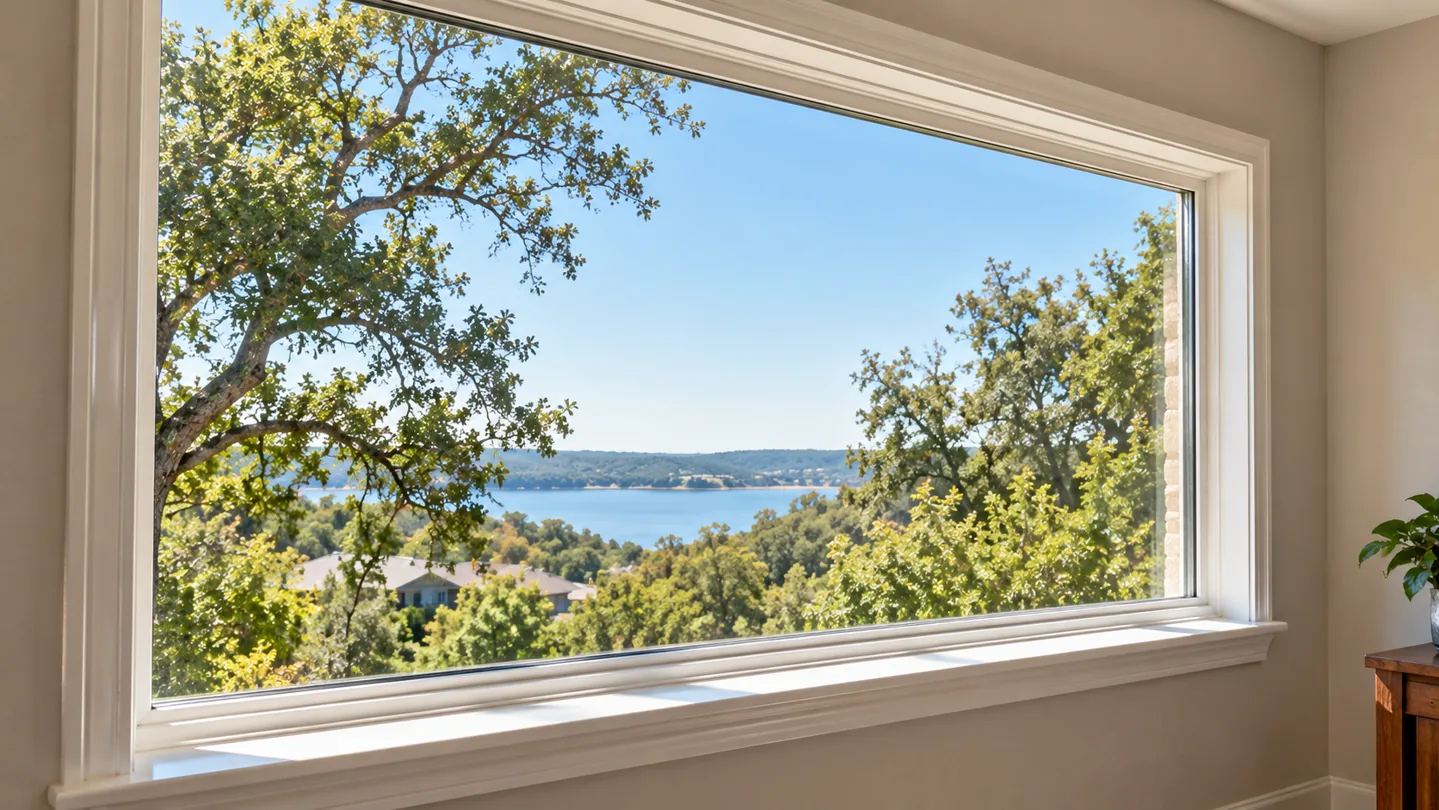
A window on the lake side of a Sunrise Beach house lives a hard life. It faces open water, full sun, wind that comes across Lake LBJ with nothing to slow it down, and the occasional Hill Country hailstorm. Sooner or later something gives: a haze appears between the panes that no amount of cleaning removes, a crack creeps across a corner after a cold front, or a stone off the mower chips the glass by the patio. Homeowners then have to work out whether they need a pane, a sealed unit, or a whole new window, and the answers online are all over the place. This guide sorts out what actually fails in residential window glass, how to tell which failure you have, and what a glass replacement visit really involves in a lake house.
What Actually Breaks in a Residential Window
It helps to separate the window into parts, because only some of them are glass.
- The glass itself is either a single pane or an insulated glass unit, which is two or three panes separated by a spacer with a sealed air or gas space between them.
- The sash is the frame that holds the glass and moves, on a single-hung or slider.
- The frame is the fixed part anchored into the wall opening.
- The hardware is the locks, balances, rollers, and cranks.
- The screen is its own assembly with a frame, spline, and mesh.
When someone says "my window is broken," any one of these could be the problem. A cracked pane in a sound frame is a glass job. A window whose vinyl frame has warped and no longer closes is a window-replacement job, not a glass job. Telling the two apart before anyone orders anything saves real money, and it is the first thing we look at.
Single Pane vs Double Pane in a Hill Country Lake House
Older Sunrise Beach cabins and additions often have single-pane windows, sometimes in aluminum frames. Newer construction is almost always double pane, called an insulated glass unit.
| Single pane | Insulated glass unit | |
|---|---|---|
| Construction | One sheet of glass in the sash | Two or three panes with a sealed spacer between |
| Heat performance | Poor; glass conducts readily | Much better; the sealed space slows heat transfer |
| Condensation | Depends on temperature and humidity | May reduce condensation; conditions matter |
| Noise | Transmits boat and road noise | Acoustic performance depends on the unit |
| Typical failure | Cracks, chips, breakage | Seal failure and fogging, plus cracks and breakage |
| Replacement approach | Cut and set a new pane in the sash | Replace the whole sealed unit |
The key practical difference: you cannot replace just one pane of an insulated unit. The two panes and the spacer are manufactured as a sealed assembly. When any part of it fails, the unit is replaced as a unit and set back into the existing sash and frame. That is good news, because it means a fogged or cracked double-pane window very often does not require a whole new window.
Failed Seals and the Fog Between the Panes
Fog between the panes can indicate a sealed-unit problem. First distinguish internal haze from moisture or residue on an accessible surface; do not dismantle the sash to investigate.
Here is what happened. The spacer between the panes contains a desiccant that absorbs the small amount of moisture sealed inside at the factory. The perimeter seal keeps outside humidity from getting in. Over years of thermal cycling, the glass expands and contracts, the seal flexes, and eventually it develops a breach. Humid air works into the cavity, the desiccant saturates, and moisture starts condensing on the inner glass surfaces.
Sun exposure, temperature changes, moisture and drainage conditions can affect a window assembly. Report persistent between-pane haze and any water pooling at the sill so the inspection considers the whole opening, not just its appearance.
Signs of a failed unit:
- Haze, film, or visible droplets between the panes
- A cloudy area that grows and shrinks with the weather and time of day
- Mineral streaking or a whitish residue etched onto the inner surfaces
- The window feeling less effective than it used to at holding temperature
Cleaning the exposed surfaces does not restore a failed sealed unit; discuss an appropriate replacement after confirming the cause. A treatment that clears visible haze is not necessarily restoration of the unit's original sealed construction or thermal performance. The sound approach is a new insulated glass unit in the existing sash. We handle that as part of our residential glass services, measuring the existing unit precisely so the replacement drops into the opening it was made for.
Cracked, Chipped, or Shattered: Reading the Damage
Not all damage means the same thing. Here is how we sort it.
Chips and surface damage
A small chip at the edge or a pit in the face from a rock may weaken the pane even when it looks minor. Glass fails from flaws, and an edge chip is where a crack is most likely to begin when the temperature swings. Worth watching, and worth replacing if it is spreading.
Stress cracks
These start at an edge and run in a gentle curve, often with no impact anywhere. They come from temperature differential, such as a cold front hitting sun-warmed glass, or from a frame that has racked slightly and is pinching the pane. Stress cracks do not heal and they do grow. If a house has several, we look at the frames, not just the glass.
Impact cracks
Impact leaves a starburst or a point of origin you can see. Hail, a thrown rock, a ladder, a bird. Impact damage in a single pane is a straightforward glass replacement. Impact damage on the exterior pane of an insulated unit means the unit is replaced, even though the inner pane is intact, because the assembly is sealed.
Shattered glass
Tempered glass breaks into a field of smaller fragments that can still cut all at once. Annealed glass breaks into shards. Either way, treat it as a hazard: keep children, pets, and bare feet away, do not push on any remaining glass in the frame, and keep the area isolated and arrange professional securing of the opening rather than trying to remove glass or board over it yourself. A technician removes the remaining glass and the old glazing compound or tape safely and sets the new glass properly bedded.
| What you see | Likely cause | Usual fix |
|---|---|---|
| Haze between panes, cleaning does not help | Failed perimeter seal | Replace the insulated glass unit |
| Curved crack that begins at an edge, no impact mark | Thermal or frame stress | Replace the glass, check the frame |
| Starburst with a clear impact point | Hail or debris strike | Replace the pane or the sealed unit |
| Chip at the edge of the glass | Contact damage | Keep clear of damaged glass; arrange assessment |
| Whole pane broken into smaller fragments that can still cut | Tempered glass impact | Professional securing, removal and appropriate safety-glazing replacement |
| Window closes poorly, glass is fine | Sash, balance, or frame issue | Diagnose hardware, not glass |
Tempered vs Annealed Glass, and Where Safety Glass Belongs
Annealed glass is ordinary window glass. Tempered glass is heat-treated so its surfaces are in compression, which makes it several times stronger and makes it break into smaller fragments that can still cause injury instead of long shards. Safety glazing reduces some injury risks but does not make a broken pane safe to approach or handle.
Building requirements in Texas, as in the rest of the country, call for safety glazing in what are broadly described as hazardous locations. In general terms, that includes glass in and around doors, glass in tub and shower enclosures, glass close to walking surfaces and stairways, and large panes set low enough that someone could walk into them. The specifics depend on the size of the pane, how close it is to the floor, and how close it is to a door. We look at each opening on site and identify which ones require safety glazing, rather than guessing from a photo.
Two practical points for Sunrise Beach homeowners:
- Tempered glass cannot be cut or drilled after tempering. Every tempered pane is made to its final dimensions, which is why accurate measurement matters and why a tempered unit is ordered rather than pulled off a shelf.
- Tempered glass typically carries a small permanent etched mark, usually in a corner. If you want to know whether an existing pane is tempered, look for that stamp.
The same logic drives glass thickness in bathrooms, which is why our frameless shower door installations use heavy tempered glass throughout. It is the same material discipline applied to a different opening.
Lake-Facing Glass, Sun, and Storms
Windows on the water side of a Sunrise Beach house have their own set of problems.
Ultraviolet exposure. Sun coming off the lake surface adds reflected light on top of direct light. Over years that fades flooring, furniture, and window treatments, and it ages vinyl and gasket materials. Low-emissivity coatings affect heat transfer, while solar-control and ultraviolet performance depend on the specified product. Ask which replacement glazing is available and review its published ratings rather than assuming every coating performs alike.
Wind and debris. Open water gives wind a long uninterrupted run. Loose patio furniture, umbrellas, and yard debris become projectiles in a strong Hill Country storm.
Hail. Central Texas hail can break glass outright or pit it badly enough that it never looks right again. After a storm, check the exterior face of each window in raking light, look for new pitting or chips at the edges, and look inside for any pane that has begun to fog in the weeks afterward, since impact can start a seal failure that takes time to show.
Hard water and mineral spotting. Irrigation spray hitting glass leaves mineral deposits that etch the surface over time. On the lake and in limestone country, our water carries plenty of minerals. Aim sprinkler heads away from glass, and clean any overspray off promptly rather than letting it bake on.
Humidity and screens. Screens corrode and stretch in a lakeside environment, and mesh that sags lets in exactly what it was installed to keep out. Rescreening is far simpler than most people expect.
Repair or Replace: How We Decide
Timing depends on safety and condition; use this framework to discuss the next step after inspection.
Glass only, keep the window when the frame is square and sound, the sash operates, the hardware works, and the damage is limited to the glass. This covers most fogged units, most cracked panes, and most hail strikes. It is the least disruptive and the least expensive path.
Glass plus hardware when the glass is damaged and the balances, locks, or rollers are also worn. Doing both on one visit avoids a second trip.
Whole window replacement when the frame itself is rotted, warped, or racked, when a wood sash has failed, or when the window no longer seals no matter what is done to the glass. At that point new glass in a bad frame is money spent twice.
Deferred, with a plan when the damage is a small edge chip that is stable and out of the way. We will tell you when something can reasonably wait and what would change that.
We put all of this in writing after looking at the openings in person, because glass sizes, thickness, tempering requirements, and frame condition simply cannot be assessed from a description. Estimates are free and no-obligation, and the pricing is in writing before any work begins.
What We Do and What We Do Not Do
Door Pro Plus is a residential company serving Marble Falls and the surrounding Hill Country. Being clear about scope saves everyone time.
We do: replace window glass and insulated glass units, repair and replace residential window glass in existing frames, install custom glass, build and install glass railings, design and install frameless shower enclosures, and handle other custom residential glass work. Our full list is on the services page, and finished projects are on our project gallery.
Scope to confirm: Storefront work, siding, roofing and insurance-claim administration are not services confirmed by the live pages reviewed for this article. Do not assume they are included in a residential glass proposal. If the frame or sash needs separate work, ask who is responsible before glass is ordered; the listed window service concerns the glass itself.
What a homeowner can safely do: identify which window and which pane, note whether the haze is between panes or on a surface you can touch, look for an etched tempering mark in a corner, measure roughly for your own reference, photograph the damage for your records, and keep people clear and arrange professional securing of a broken opening.
What to leave alone: removing broken glass from a sash, prying at glazing beads, attempting to separate an insulated unit, or standing on furniture to reach a high window. Broken glass edges are sharp in ways that are easy to underestimate, and a sealed unit is heavier than it looks.
If you are not sure which category your window falls into, call us at (830) 385-2449 and describe what you are seeing. The call helps plan an assessment.
What a Glass Visit in Sunrise Beach Looks Like
The sequence is consistent. A technician looks at each affected opening, confirms whether the failure is glass, sash, or frame, checks whether the location calls for safety glazing, and measures precisely, including glass thickness and the depth of the channel the glass sits in. We then provide written pricing.
Because residential glass is cut and, where required, tempered to the exact opening, the supply and installation sequence depends on the specified product. Confirm whether measurement and installation require separate visits and what lead time applies. Garage door repairs are different, and most repair calls placed before noon get consideration for same-day service, subject to schedule and parts availability. Glass follows the fabrication schedule, and we will tell you what to expect when we measure.
Our hours are Monday through Friday, 8am to 5pm. We use name-brand parts and quality glass rather than budget imports, which matters most on the pieces you look through every day.
Frequently Asked Questions
Can a foggy double-pane window in my Sunrise Beach house be repaired?
Not in any lasting way. The fog means the perimeter seal that keeps humid air out of the space between the panes has failed, and the desiccant inside is saturated. Drilling and venting the unit clears the haze temporarily but leaves an unsealed cavity. The proper fix is a new insulated glass unit set into your existing sash, which keeps the window and frame you already have.
Do I have to replace the whole window, or just the glass?
Usually just the glass. If the frame is square and sound and the sash still operates, a new pane or a new sealed unit goes into what you have. Frame or sash damage may require a separate window-replacement assessment. We determine which applies by inspecting the opening in person before anything is ordered.
How do I know if my window needs tempered safety glass?
It depends on where the glass sits. Building requirements generally call for safety glazing in and around doors, in tub and shower enclosures, near stairs and walking surfaces, and in large low panes someone could walk into. Existing tempered glass usually has a small etched mark in one corner. We identify which openings require it during the on-site measure.
What should I do right after a window breaks?
Keep people and pets away from the area, do not pick glass out of the sash, and do not lean on any remaining pane. Board or tape plastic over the opening to keep weather and animals out. Photograph the damage for your own records. Then call us so a technician can clear the remaining glass safely and measure the opening properly.
Does Door Pro Plus do residential glass work in Sunrise Beach?
Yes. Sunrise Beach is part of our Texas Hill Country service area, along with Kingsland, Llano, Buchanan Dam, Tow, Horseshoe Bay, and Marble Falls, where our shop is. We handle window glass, insulated unit replacement, glass railings, frameless shower enclosures, and custom residential glass. Call us Monday through Friday, 8am to 5pm to arrange a measure.
Why does lake-facing glass seem to fail sooner?
Lake-facing windows take direct sun plus light reflected off the water, big daily temperature swings, humid air, and wind-driven debris. All of that works on the perimeter seal of an insulated unit and on the surface of the glass. Adding hard-water overspray from irrigation and occasional hail, the water side of a house simply puts more stress on glass than a shaded north wall does.
Get Your Sunrise Beach Glass Looked At
If a pane is cracked, a unit has gone cloudy, or a hailstorm left marks you are not sure about, the practical next step is having someone measure and look. We serve Sunrise Beach and the Lake LBJ communities from Marble Falls, and we cover neighboring areas including Kingsland across the lake.
Call Door Pro Plus at (830) 385-2449, Monday through Friday, 8am to 5pm. We will inspect the glass, explain what failed and why, and give you a free, no-obligation estimate with pricing in writing before any work begins.
Need garage door or glass service?
Door Pro Plus serves Marble Falls, Horseshoe Bay, Burnet, Llano, Kingsland, and the Texas Hill Country. Call 830-385-2449 for a free estimate.