
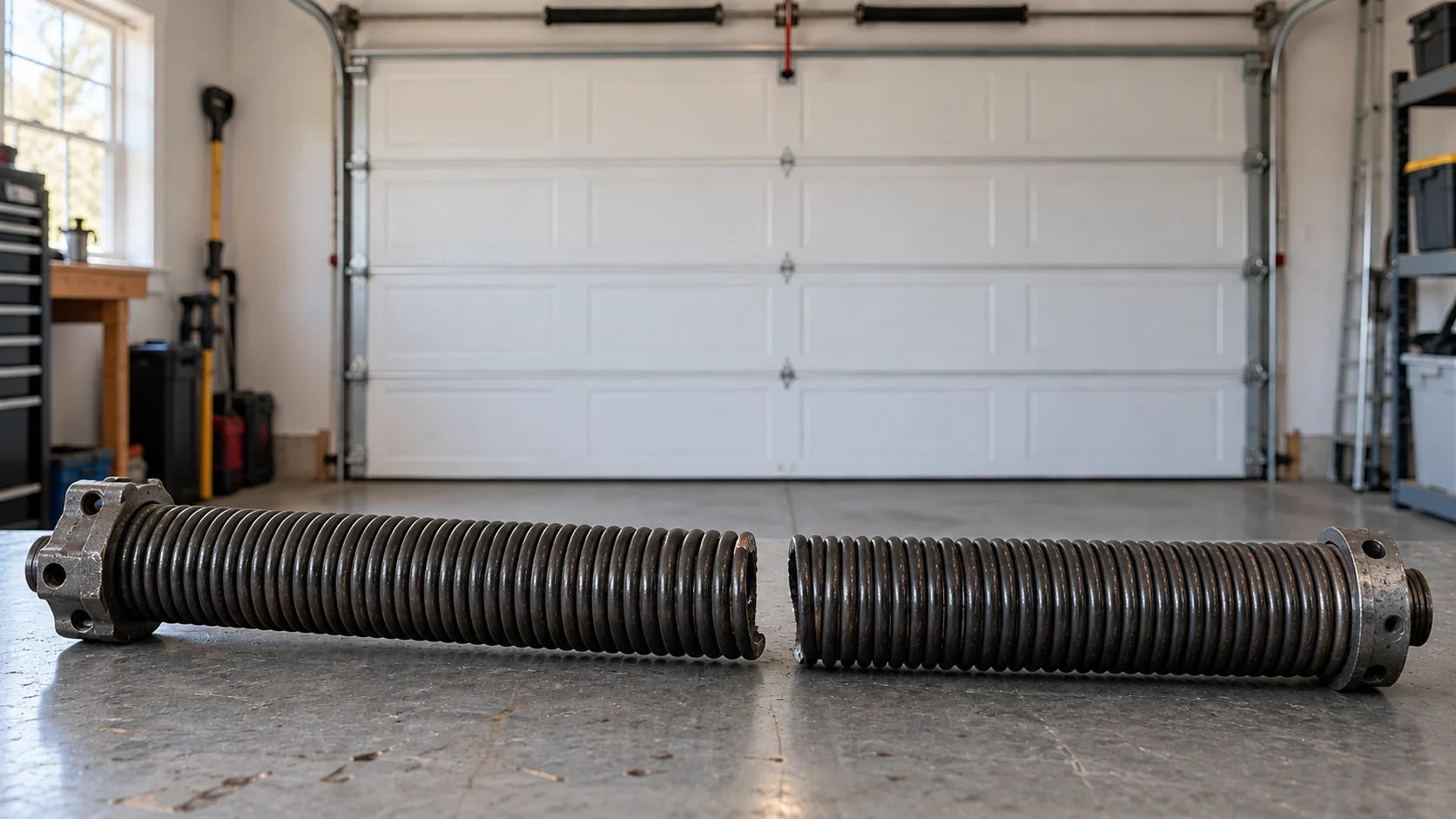
A loud bang followed by a garage door that will not move can be a warning of a broken spring. For a Marble Falls homeowner, the important next step is not another press of the opener button: it is stopping use and keeping everyone clear of the opening. A gap in a spring, a crooked door, slack cables or a change in movement needs a technician's assessment. Several faults can produce similar symptoms, so sound alone is not a diagnosis. This January guide explains how the counterbalance system works, which observations are useful when you call, and why spring repairs are never a homeowner project. You do not need to lift the door, touch the spring or pull a release cord to gather the basic information.
What Actually Broke When You Heard That Bang
The springs counterbalance a residential garage door's weight, while the opener moves that balanced system. If the counterbalance fails, the opener may be unable to move the door safely. Required lifting effort varies with the door and its condition, so an apparently strong opener does not establish that the springs, cables or brackets are sound.
A spring under load stores an enormous amount of mechanical energy. When the steel fatigues and the coil separates, that energy releases in a fraction of a second. Inside a torsion spring, the two halves slam apart along the shaft. That is the bang. On extension spring systems, the spring can whip along its length, which is why safety cables running through the spring body matter so much.
Common signs, beyond the noise:
- A visible gap of one to two inches in a coil above the door opening
- The door lifts four to six inches, then stops or slams back down
- The opener hums, strains, or clicks and the door barely moves
- The door looks crooked in the opening, with one side higher than the other
- Frayed, loose, or slack cables hanging alongside the vertical tracks
- Loud grinding or the door feeling suddenly, dramatically heavier by hand
Any one of those means the door should stay closed and stay unused until a technician has looked at it. We treat these as priority calls for a reason.
Why Springs Break in a Marble Falls Cold Snap
A change in temperature may coincide with a garage-door problem in Marble Falls, but timing alone cannot establish that the weather caused it. Existing wear, corrosion and the condition of the complete door system need inspection. Report when the symptoms started without repeating an unsafe operation to demonstrate them.
Springs are specified by cycle ratings, not a fixed replacement age. One cycle means one full opening and closing. For a stated 10,000-cycle rating, four complete cycles daily equal about 1,460 cycles annually; dividing the rating by that usage gives roughly 6.8 years. That is arithmetic, not a prediction of actual life. Condition, loading, maintenance and the installed specification can change the outcome.
Cold mornings can make an existing problem more noticeable, but a weather change does not identify the cause. Normal cycling, corrosion, door condition and the suitability of the installed spring system all matter. Lubrication and hardware should be inspected according to the door manufacturer's guidance; do not spray or adjust a suspect spring yourself.
Instead of assuming a cold snap caused the failure, note when you first noticed the problem and whether there had been a change in noise, movement or appearance. A technician can inspect the entire door, not just the spring that looks damaged. The purpose of that inspection is to find the actual cause and determine what work is necessary before the door returns to use.
Torsion vs. Extension Springs
Knowing which system you have helps you describe the problem accurately over the phone, which helps us arrive with the right parts. You can identify it by looking from a safe distance, without touching anything.
| Torsion springs | Extension springs | |
|---|---|---|
| Where they sit | On a steel shaft above the door opening | Along the horizontal tracks, parallel to the ceiling |
| How they work | Wind and unwind around the shaft | Stretch and contract along their length |
| Typical count | One or two, sized to door weight | Commonly a pair, one per side |
| Break appearance | A clean gap in the coil, often near the cone | Stretched, separated, or dangling, pulley sometimes loose |
| Safety cable | No cable through coils; other parts can remain loaded | Should run through the spring to contain it |
| Common on | Modern and heavier doors, including insulated | Older, lighter single-car doors |
| Balance behavior | Balanced across the full width | Can go out of balance side to side |
On a two-spring torsion system, the pair may have similar age and use. Door Pro Plus's service information says paired replacement is typically recommended when one fails, but the technician should inspect both and explain the correct specification. Do not assume a failure date for the remaining spring. You can read more about both systems on our garage door spring repair and replacement page.
Why the Door Is Too Heavy Now, and Why This Is Never DIY
The weight problem
Homeowners often try to muscle the door up by hand after a spring breaks, and that is where injuries start.
A single-car steel door commonly weighs around a hundred and fifty pounds. A double-wide insulated door with glass inserts can be well over three hundred. With intact springs, nearly all of that weight is counterbalanced, so you feel only a few pounds of resistance. With a broken spring, you feel the entire door.
Worse, that weight is not stable. It is on rollers, in tracks, attached to cables that are now slack and can jump their drums. Lift it partway and it may drop without warning, or unspool unevenly and wedge in the opening. Fingers, feet, and vehicle hoods are all in the path.
Running an opener against a broken spring can damage additional components. The motor is sized for a balanced door. Force it to lift dead weight and you can strip the drive gear, bend the rail, burn out the logic board, or tear the opener bracket out of the panel. If you have already tried it once or twice, tell us. It gives the technician useful information before inspection.
The safe response is simple: leave the door closed, do not use the opener, park outside if the car is trapped inside, and call. If the door happens to be stuck open, keep people and pets clear of the opening entirely and call from outside.
Why the repair itself belongs to a technician
We are not saying this to protect our own work. We say it because the failure modes are genuinely severe, and because the internet is full of videos that make this look manageable.
A torsion spring is wound under hundreds of pounds of force using specialized bars. If one slips, or if a screwdriver is used instead, or if a set screw is loosened in the wrong order, the stored energy releases through whatever is closest. That is typically a hand, a wrist, a jaw, or a skull. Hospitals treat these injuries every year, and they are not minor.
The specific things nobody outside the trade should ever touch:
- Springs. Do not grab, pull, pry, cut, or "test" a spring, broken or intact. A spring that looks broken can still hold residual tension.
- Winding bars and cones. Winding and unwinding a torsion spring is the single most dangerous step in the trade. It requires the correct bars, the correct sequence, and hands-on training.
- Set screws. Loosening a set screw on a drum or a spring cone releases the shaft. Do not touch them.
- Cables and drums. Slack cable is still attached to a door under load. Unwrapping a cable from a drum can drop the door instantly.
- The shaft, bearing plates, and center bracket. All part of the tensioned assembly.
- An off-track door. Do not try to lever a door back into its tracks. It can fall.
- A panel under tension or a bent section. Leave it in place.
Sizing is the other half of the problem. Springs are specified by wire diameter, inside diameter, length, and wind direction, matched to the weight and height of your door. A spring bought off a shelf because it looked about right produces a door that is either too heavy to control or so light it flies up and slams the top section into the header. That specification is a measurement job, not a guess. Our full range of garage door repair services covers springs, cables, drums, rollers, tracks, and panels precisely because those parts all have to work as one balanced system.
What You Can Safely Do Yourself
Plenty of the diagnostic work is safe, and doing it well makes your service call faster. Nothing here involves touching a component under tension.
Look. Stand back and scan the spring above the opening or along the horizontal tracks. Note a visible gap, a dangling spring, or a spring that looks stretched out. Note whether cables look taut, slack, or frayed, and whether the door sits square in the opening.
Listen. Describe the bang, grinding or clicking you already heard, and when it happened. Those sounds can help a technician narrow the assessment, but they do not prove a particular part failed. Do not run the door again simply to reproduce a noise.
Keep the door out of service. A remote battery or sensor fault does not explain away a possible spring failure. Do not operate the opener, pull the release cord, try to lift the door or test its balance while damage is suspected.
Observe from outside the travel path. You can note a blocked sensor lens, objects near the opening or the position of the door without reaching into the mechanism. Leave debris near tensioned components alone. A technician should secure and inspect the system before maintenance or movement tests.
Leave lubrication and balance checks for the visit. Routine maintenance belongs on a sound door under the manufacturer's instructions. It is not a troubleshooting step for a door with a possible broken spring, loose cable, bent panel or off-track roller.
Write down the model. The opener brand and model number are usually on the motor housing. We service all major opener brands, including LiftMaster, Chamberlain, and Genie.
What Same-Day Priority Handling Looks Like
Broken springs and doors stuck off-track are treated as priority calls. Most repair calls placed before noon get consideration for same-day service, subject to schedule and parts availability. Our hours are Monday through Friday, 8am to 5pm, and calling early is what makes same-day scheduling possible. Here is how the visit usually goes:
- You call and describe what you saw and heard. The detail from the safe checks above matters. A visible gap in a coil above the door tells us to load torsion springs sized for your door type.
- We inspect the door in person. We measure the door, check spring wire size and length, and look at cables, drums, bearings, rollers, tracks, and the opener for secondary damage.
- You get a written, upfront quote before anything is touched. Estimates are free and no-obligation, and the price is in writing before work begins.
- The work happens. The technician performs the agreed work, checks the complete door system, and verifies balance and opener safety before returning it to service. Repair timing depends on the diagnosis and availability of the correct parts.
- Discuss the final checks. Ask the technician how balance, travel, contact reversal and photo-eye function will be verified before the door returns to service.
We use name-brand parts and quality glass, not budget imports, and we inspect the door and specify components for the actual system. Our customer reviews let you read homeowners' accounts of their service experiences.
What We Do, and Where We Work Around Marble Falls
Accuracy beats puffery, so here is the honest scope.
What we do:
- Torsion and extension spring repair and replacement on residential doors
- Cable, drum, bearing, roller, hinge, and track repair, plus off-track correction and panel work
- Opener sales, installation, and repair across all major brands
- New garage door installation and full replacement
- Frameless shower door installation and residential glass work
- Free, no-obligation estimates with pricing given in writing before work starts
What we do not do:
- Work on anything but homes. Residential doors and residential glass are the whole of it.
- Work outside Monday through Friday, 8am to 5pm. If a spring breaks Friday evening, keep the door closed and call Monday morning.
- Quote spring work over the phone. Sizing and pricing require an in-person inspection.
- Talk you into a new door when a repair is right, or patch a door that is genuinely done.
You can see the whole scope on our services overview.
Marble Falls is our home base, at 2409 Commerce St Ste 2, in Marble Falls, Burnet County. That puts us close to most of the neighborhoods we serve. Details on local coverage live on our Marble Falls service area page.
We also cover the lake communities and the wider region, including Horseshoe Bay, Kingsland, Sunrise Beach, Buchanan Dam, Tow, Burnet, Llano, Lampasas, Johnson City, and Spicewood. Homes near the water deal with a mix of humidity and heat that is hard on hardware, and readers there can start with our Horseshoe Bay service page. If you need a technician today, call (830) 385-2449 and describe what you saw.
Frequently Asked Questions
How do I know if my garage door spring is broken or if it is the opener?
A visible separation in a spring is a serious warning, but springs that appear continuous are not proof that the door is safe. Broken springs, cable faults and opener problems can have overlapping symptoms. Observe from a safe distance, stop operating the door, and tell the technician what you saw and heard without lifting it or testing the release.
Can I still open my garage door by hand after a spring breaks?
You should not. With a broken spring the door carries its full weight, which can exceed three hundred pounds on a double insulated door, and the slack cables can jump their drums and let the door drop. If a vehicle is trapped inside, the safest choice is to park elsewhere until a technician arrives. Do not lift the door partway and try to prop it.
How long do garage door springs last in the Marble Falls area?
Springs have cycle specifications rather than a fixed lifespan. For illustration, dividing a stated 10,000-cycle rating by four complete cycles daily and 365 days gives about 6.8 years. Actual life can differ with condition and use. Ask the technician to identify the installed specification; the arithmetic alone does not establish when replacement is necessary.
If one spring broke, do both need to be replaced?
On a two-spring torsion system, the springs may have similar age and use, making a matched replacement worth discussing. A technician should inspect both, confirm the door's requirements and explain the recommendation rather than predict when the second spring will fail. Do not operate the door with a broken spring while waiting for that assessment.
Can you replace a broken spring the same day I call?
Broken springs and off-track doors are treated as priority calls, and most repair calls placed before noon get consideration for same-day service, subject to schedule and parts availability. Our hours are Monday through Friday, 8am to 5pm. Calling early in the day gives you the best chance at same-day service, and repair timing depends on the diagnosis and required parts.
What does a broken spring repair cost?
We do not quote spring work over the phone, because the correct spring depends on the door's weight, height, and configuration, and because secondary damage to cables, drums, or the opener changes the job. Estimates are free and no-obligation. We inspect the door in person, then give you the full price in writing before any work begins. Ask what the quote includes before approving work.
Call Door Pro Plus in Marble Falls
If you heard a bang, saw a spring gap or found a door that will not move, stop using it and call Door Pro Plus at (830) 385-2449. We are available Monday through Friday, 8am to 5pm. Describe the symptoms without repeating an unsafe test. Estimates are free and no-obligation, with the proposed work in writing after inspection; the call will establish availability rather than promise a completion time.
Need garage door or glass service?
Door Pro Plus serves Marble Falls, Horseshoe Bay, Burnet, Llano, Kingsland, and the Texas Hill Country. Call 830-385-2449 for a free estimate.