
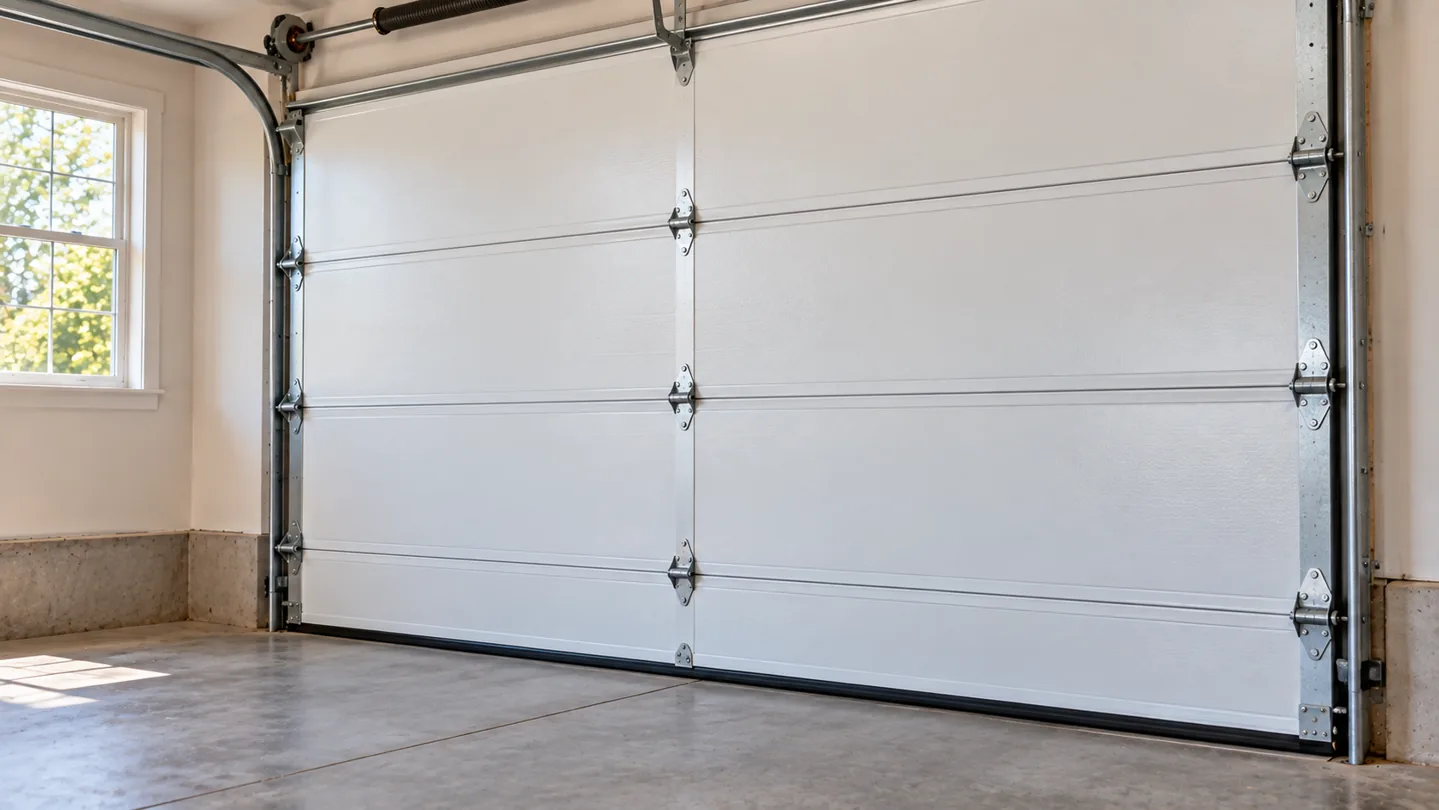
A Lampasas garage can become uncomfortable during July, especially when a door receives direct sun and the space is not conditioned. An insulated door may reduce heat transfer through its panels, but it does not cool the garage like an air conditioner or correct every weakness in the surrounding building. Orientation, air leakage, ceiling construction and how the space is used all affect the result. If the opener is also behaving differently, that needs diagnosis rather than an assumption that insulation will solve it. This guide explains the construction options, why perimeter sealing matters, and how to discuss a replacement without treating an R-value as a complete comfort promise. Door Pro Plus lists residential door installation and opener service for the surrounding Hill Country.
Why a Lampasas Garage Runs Hotter Than the Rest of the House
A garage's thermal protection depends on its construction. A non-insulated door exposed to sun, a heat-storing slab and limited air movement can contribute to discomfort. During hot weather in Lampasas County, an attached garage with a non-insulated door can sit well above the outdoor temperature by late afternoon.
That heat does not stay put. It conducts through the shared wall into the house, it rises through the ceiling into any bonus room or bedroom above the garage, and it soaks into the slab so the space is still warm at midnight. If your upstairs room over the garage is always the one nobody wants to sleep in during August, the garage door is a strong suspect.
A hot garage is also a hot mechanical room. The opener, its logic board, the springs, the rollers, the grease on the hinges, and the rubber seal at the bottom of the door are all living in that heat every day from June through September.
How Garage Door Insulation Actually Works
Insulation in a garage door is measured in R-value, a number describing how well a material resists heat moving through it. Higher R-value means slower heat transfer. A single-layer steel door has essentially no meaningful resistance; it is a sheet of metal, and metal is very good at passing heat along. Add an insulating core and the same door starts behaving like a wall instead of a griddle.
The construction matters as much as the number:
- Single-layer doors are one skin of steel with no core. They are the lightest and the ones that get hottest.
- Double-layer doors add an insulating core bonded to the back of the steel skin, with a thin vinyl backer.
- Triple-layer doors sandwich the core between two steel skins. These are the quietest, the most rigid, and the ones that hold up best to a stray basketball.
The two cores you will actually be choosing between are polystyrene and polyurethane.
Polystyrene vs Polyurethane
| Feature | Polystyrene core | Polyurethane core |
|---|---|---|
| How it is made | Rigid foam panels cut and fitted into each section | Foam injected as a liquid, expands to fill the section |
| Fit inside the section | Good, with small gaps at edges and struts | Fills every void and bonds to the steel |
| Relative R-value per inch | Lower | Higher |
| Door rigidity | Moderate improvement | Significant improvement |
| Noise reduction | Some | Noticeably more |
| Typical use | Budget-conscious upgrade over a bare door | Attached garages, rooms above the garage, workshops |
For a detached garage used for storage, a polystyrene door is a real improvement over nothing. For an attached Lampasas garage with living space above it or a shared wall against a bedroom, polyurethane is the one worth the conversation. It gets you more resistance in the same thickness, and the foam bonding to the steel makes the section stiffer.
We walk through these options in person during a garage door installation and replacement consultation, because the right answer depends on how the garage is built and what you use it for, not on a number in a brochure.
R-Value Numbers Are Not the Whole Story
Manufacturers publish R-values, and homeowners naturally shop by them. Two cautions are worth knowing. First, the published figure usually describes the insulated section at its thickest point; rails, stiles, and the joints between sections are not insulated to the same degree, so a section R-value cannot be treated as a tested whole-door result. That is simply how a sectional door is built.
Second, and far more important, R-value only describes heat moving through the material. It says nothing about heat moving around it. Air leakage around a door can undermine the benefit of an insulated panel; assess both rather than relying on a single product rating.
Insulation Without a Good Seal Is Half a Door
Picture a well-insulated door hanging in an opening with a worn-out bottom seal, cracked perimeter weatherstrip, and daylight visible along one jamb. That door is doing part of its job and losing the rest to plain air exchange.
The seal system on a residential sectional door has several parts:
- Bottom seal (astragal): the flexible strip in the retainer along the bottom section, the hardest-working piece on the door and the first to fail.
- Perimeter weatherstrip: the flexible flap on the jambs and header trim that the door closes against.
- Between-section seals: the interlocking shiplap profile where two sections meet.
- Threshold: an optional strip bonded to the slab, useful when the concrete is uneven or slopes toward the door.
Hill Country conditions are hard on all of it. Ultraviolet exposure on a west-facing door makes rubber brittle. Slabs shift with our clay and limestone soils, so a bottom seal that once sat flat now touches on one side and gaps on the other. Blowing dust and grit from county roads works into the retainer and grinds at the rubber every cycle.
Here is a simple check anyone can do safely. Close the door completely on a bright afternoon, then stand inside the garage with the lights off and look along the bottom, up both sides, and across the header. Any line of daylight is a line of hot air. Note where it is and how long it runs; that description is useful to a technician on the phone.
Replacing worn seal and weatherstrip is straightforward work and part of routine garage door repair. On a door otherwise in good condition, new seals can make a bigger difference in comfort than several points of R-value would.
What Texas Heat Does to the Rest of the Door
Insulation is the headline, but heat works on everything else in that garage too. Four things go wrong often enough in a Hill Country summer to discuss during a professional assessment.
Opener electronics
An opener's electronics and mechanical components have product-specific operating-temperature limits, which should be checked in its manual. Heat is hard on circuit boards, capacitors, and the logic components that handle travel limits and safety reversal. The classic pattern is an opener that works perfectly at seven in the morning and gets unreliable by four in the afternoon.
Thermal cutouts matter too. Many openers include a protective shutdown if the motor overheats, and a hot ceiling space plus several cycles in a row can trip it. That is the unit protecting itself, not failing.
Heat also stacks on top of our other summer hazard, the power surge. A fault after a storm may involve electrical damage or another cause. If the fault started after a storm, report that timing, but do not assume the board is the cause before diagnosis. We handle diagnosis and replacement as part of our garage door opener service, including LiftMaster, Chamberlain, and Genie units as well as other major brands.
Lubricant breakdown
Grease and oil thin out as temperatures climb. Lubricant that was doing its job in March migrates off the rollers and hinges by July, leaving metal running against metal. The first sign is noise: a squeal on the way up, a chirp at one point in travel, or grinding near the top of the opening.
For a sound door, use only the product and accessible homeowner lubrication points specified by its manufacturer. Keep the door fully closed and prevent unexpected operation as the manual directs. Leave spring coils, bearings near loaded assemblies, drums, cables and brackets to the technician. Do not grease the tracks, and do not attempt maintenance on a door that is crooked, heavy or binding.
Seal and rubber degradation
Beyond the door seals, rubber and plastic components throughout the system age faster in this climate. Nylon roller wheels get brittle, and vinyl trim cups and cracks.
Thermal expansion and binding
Steel expands when it heats. A door adjusted in cool weather can bind slightly in a track at the peak of a summer afternoon, especially if the tracks were already a fraction out of alignment. Symptoms include a door that hesitates at one point in travel, a shudder, or an opener that strains only during the hottest part of the day. Binding accelerates wear on rollers, hinges, and the opener, so it is worth a look.
What an Insulated Door Will and Will Not Do
We would rather set expectations correctly than sell someone a result they will not get.
An insulated door will:
- Meaningfully lower peak garage temperature on a hot afternoon
- Reduce how much heat conducts into a shared wall or a room above the garage
- Make the garage far more usable as a workshop or storage space in July and August
- Run quieter and hang more rigidly, which helps it survive daily use
An insulated door will not:
- Turn an unconditioned garage into an air-conditioned room
- Fix a room above the garage whose real problem is an uninsulated attic floor, leaky ductwork, or a missing air barrier in the garage ceiling
- Compensate for a failed bottom seal or a gap along the jamb
- Do much for you if the garage has a large uninsulated wall or a single-pane window baking in the sun
When a homeowner tells us the bonus room over the garage is unbearable, an insulated door usually helps, and it is rarely the only thing that needs attention. We will tell you that in person rather than let you expect a transformation the door cannot deliver on its own.
Choosing an Insulated Door for a Lampasas Home
A few practical considerations come up on nearly every consultation in Lampasas County.
Orientation. A west-facing door takes the worst of the afternoon and benefits most. A shaded north-facing door is a lower priority.
Attached or detached. Attached garages, especially with living space above or beside them, justify a higher-performing core.
Color. Darker door colors absorb more heat. It is a genuine factor on a sun-exposed elevation.
Weight and hardware. This is the one homeowners never think about and the one that matters most mechanically. An insulated door is heavier than the single-layer door it replaces, sometimes substantially. The springs, cables, drums, and opener all have to be matched to the new weight. A heavier door on undersized springs will wear out springs early, strain the opener, and hang unbalanced. Correct spring sizing to the actual door weight is part of a proper installation, and it is not something to guess at.
| Situation | Likely best move |
|---|---|
| Bare single-layer door, west-facing, attached garage | Insulated replacement, polyurethane core |
| Good insulated door, daylight along the bottom | New bottom seal and perimeter weatherstrip |
| Insulated door, garage still very hot, ceiling uninsulated | Address door seals, then look above the ceiling |
| Detached storage garage, tight budget | Polystyrene core or seal work first |
| Door fine, opener unreliable only on hot afternoons | Opener diagnosis, likely logic board or thermal cutout |
What We Do and What We Do Not Do
Door Pro Plus is a residential company. We work on houses only. Here is the honest breakdown for a heat-related call in Lampasas.
We do: inspect the door, measure the opening, weigh and balance the door, size springs correctly to an insulated replacement, replace bottom seals and perimeter weatherstrip, correct track alignment, replace worn rollers and hinges, diagnose and repair or replace openers, and install new insulated sectional doors.
We do not: insulate your attic, seal your ductwork, insulate the garage ceiling or walls, or perform general home energy work. We will tell you when the door is not the main problem so you can take it to the right trade.
Homeowner-safe tasks between visits: look for daylight around a closed door, listen for new noises, wipe the photo-eye lenses, lubricate rollers and hinges lightly, clear grit out of the tracks with a rag, and keep the area around the door clear.
Leave to a technician: anything involving the springs, the cables, the drums at the ends of the torsion shaft, or a door off its track. Those components hold enormous stored energy even when the door is sitting still, and they injure people every year. Do not loosen a set screw, do not put a bar into a spring, and do not detach a cable. Call us at (830) 385-2449 and let a technician handle the loaded parts.
A Realistic Summer Timeline in Lampasas
Seals and lubricant should be checked in late spring, before the first long run of triple-digit days. Opener trouble tends to surface in July and August, and replacement conversations often happen in September.
Our hours are Monday through Friday, 8am to 5pm. Most repair calls placed before noon get consideration for same-day service, subject to schedule and parts availability, and broken springs and doors stuck off-track are priority calls. Installations are scheduled, since a replacement door is ordered and built to the opening. Estimates are free and no-obligation, and after we inspect the door in person we put the pricing in writing before any work begins. You can read what Hill Country homeowners have said on our customer reviews page.
Frequently Asked Questions
Will an insulated garage door lower my electric bill in Lampasas?
It can help, especially with an attached garage that shares a wall or ceiling with conditioned space. Reducing heat transfer through the door may lessen the load on adjoining spaces, but an actual energy-use change depends on the whole building. The size of the change depends on your garage's orientation, how well the rest of the garage is built, and whether the door seals properly. We do not promise a specific figure, because honest numbers depend on the house.
What R-value should I look for on a garage door?
There is no single right answer. For a detached storage garage, a modest insulated door is a clear improvement over a bare one. For an attached garage with a bedroom or bonus room above it, a higher-performing polyurethane core makes more sense. What matters just as much is whether the seals are intact, since air leaking around the door undoes a good part of any core's benefit.
Can you add insulation to my existing garage door instead of replacing it?
Sometimes a retrofit kit is an option, but it changes the door's weight, which affects spring balance and opener strain. On a door that is already worn, the money is usually better spent on a properly built insulated replacement with correctly sized springs. We inspect the existing door first and tell you which option fits the door's condition and specification for your garage.
Why does my garage door opener only act up on hot afternoons?
Heat is hard on the electronics and can trip a motor's thermal protection after several cycles. Aging logic boards, capacitors, and connections get less reliable as the ceiling space heats up. Lubricant thinning out and a door binding slightly in the track from thermal expansion add mechanical load on top of that. A technician can separate an electronic fault from a mechanical one quickly.
Does Door Pro Plus install insulated garage doors in Lampasas?
Yes. Lampasas is part of our Texas Hill Country service area, along with Marble Falls, Burnet, Llano, Kingsland, and the lake communities. We handle residential installations and replacements, measure the opening in person, size the springs to the new door's weight, and give you written pricing before ordering anything. Call us Monday through Friday, 8am to 5pm to set up a visit.
How often should the weatherseal on my garage door be replaced?
There is no fixed schedule, because sun exposure and slab condition drive it. A west-facing door in Hill Country sun ages its bottom seal much faster than a shaded north-facing one. The practical test is the daylight check: close the door on a bright day and look for light around the perimeter. When you can see a gap, the seal has stopped doing its job.
Talk to Us About Your Lampasas Garage Door
If your garage is unbearable by noon, your upstairs room never cools, or your opener has developed a summer personality, it is worth having someone look at the whole system rather than guessing. We serve Lampasas and the surrounding Hill Country from our shop in Marble Falls, and we cover the wider region as well; you can see every community we reach on our service areas page.
Call Door Pro Plus at (830) 385-2449, Monday through Friday, 8am to 5pm. We will inspect the door, explain what we find in plain language, and give you a free, no-obligation estimate with the pricing in writing before any work starts.
Need garage door or glass service?
Door Pro Plus serves Marble Falls, Horseshoe Bay, Burnet, Llano, Kingsland, and the Texas Hill Country. Call 830-385-2449 for a free estimate.