
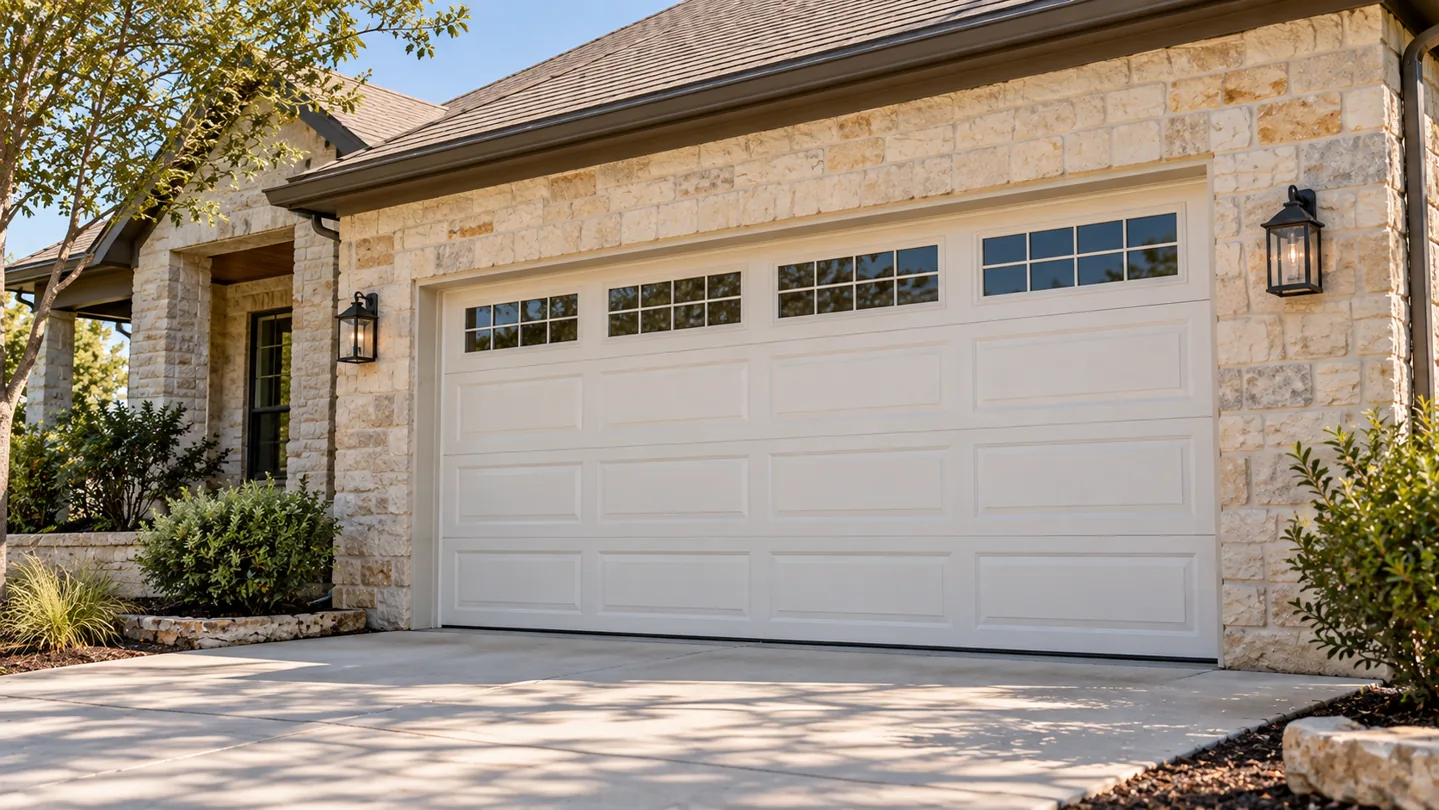
A garage door is usually the largest single design element on the front of a house, and in Spicewood, where so many homes sit on hillsides along TX-71 with the driveway facing the road, it is often the first thing anyone sees. It is also a mechanical system carrying a few hundred pounds on springs and cables, several times a day, for years. Those two facts pull in different directions: one is about how the house looks, the other is about how the door works. A good replacement satisfies both. This guide walks through the decision as a set of questions to discuss during an in-person assessment, from whether replacement is even the right move, through materials, insulation, glass and hardware, to what an in-person written estimate should tell you before anyone orders anything.
Repair or Replace: Making the Call in Spicewood
Not every failing door needs replacing. A twelve-year-old steel door with a broken spring, sound panels and straight tracks is a repair, and a good one. A door with rusted-through sections, split rails and three previous patch jobs is not.
Here is a condition-based framework to discuss with the technician.
Repair usually makes sense when:
- The failure is a single component: a spring, a cable, a roller, a hinge, a section of track
- The panels are straight, uncracked and unrusted
- The door is reasonably recent and matches the house
- The door is not causing ongoing damage to the opener through poor balance
Replacement usually makes sense when:
- Multiple panels are damaged, rusted, delaminated or rotten
- The door has been backed into and the framing or struts are bent
- Repairs are stacking up year over year on an aging door
- The door is uninsulated and the garage is attached to living space
- The door is a single-piece tilt-up or an older design with no modern safety features
- The look of the house is changing and the door no longer fits it
- Sections are no longer available to match, which happens more often than people expect
A practical middle case: a door that works but is loud, drafty and dated. There is no urgency there, which means you have the luxury of planning the replacement rather than reacting to a breakdown. That is the best time to buy a door, and it is when homeowners make the best choices. Our garage door installation and replacement service covers both the planned projects and the ones that start with a bad morning.
What Actually Drives the Cost of a New Garage Door
We do not quote prices over the phone or online, because a door quoted blind is a door quoted wrong. What we can do is tell you exactly which variables move the number, so nothing in the written estimate is a surprise.
| Cost factor | Why it matters |
|---|---|
| Door size | A single door and a double door are different products; oversized and custom openings add fabrication |
| Material | Steel, wood and composite sit at very different points, and wood species varies widely |
| Construction layers | Single-layer, two-layer and three-layer sandwich doors differ in cost, weight and durability |
| Insulation level | Polystyrene versus polyurethane, and the R-value you target |
| Window inserts | Glass adds cost by the number of lites, glass type, grille style and any obscure or insulated glazing |
| Hardware grade | Spring cycle rating, roller quality, hinge gauge and track grade |
| Opener needs | Whether the existing opener suits the new door's weight, or whether a new unit makes sense |
| Site conditions | Out-of-square openings, rotted jambs, low headroom, unusual ceiling framing |
| Removal and disposal | Taking out and hauling away the old door and hardware |
| Finish | Factory finish, a paintable primed surface, or a stained wood finish |
Two of those deserve a note. Spring cycle rating is the one homeowners never ask about and always benefit from: springs are rated in open-close cycles, and a higher-cycle spring set costs more up front while lasting considerably longer on a door that gets used constantly. Site conditions are the reason an in-person look matters. Hillside builds in Spicewood frequently have garages set into grade, with framing and headroom that nothing on a spec sheet anticipates.
What we will not do is invent a figure for you before we have seen the opening. We give you a written, upfront quote after inspecting the door in person, and the estimate is free with no obligation.
Door Materials: Steel, Wood, and Composite
Material is the biggest single decision, and in Central Texas the climate should weigh on it as much as taste does.
| Material | Strengths | Trade-offs | Good fit for |
|---|---|---|---|
| Steel | Durable, low upkeep, wide style range, takes insulation well, holds a factory finish | Can dent; thin single-layer doors dent easily; bare scratches can rust | Most homes; the default for good reason |
| Wood | Genuine warmth and grain, fully customizable, strong curb appeal on ranch and hill-country architecture | Needs refinishing on a real schedule; heavy, which drives hardware sizing; sun and moisture are hard on it | Homes where appearance leads and upkeep is accepted |
| Composite and wood-look overlays | Wood appearance with far less upkeep, dimensionally stable, resists rot and insects | Costs more than plain steel; the look is close to wood rather than identical | Hill-country styling without a refinishing schedule |
| Aluminum with glass | Modern, light, bright; full-view panels | Dents readily; glass loads the opener differently; heat gain matters in Texas | Contemporary builds and shop-style openings |
A note about steel gauge, since the number confuses everyone: lower gauge means thicker steel. A door described with a lower gauge number has more substantial skin than one with a higher number. On a double door that gets daily use, or anywhere a basketball is in play, that thickness is worth paying attention to.
Texas sun is also a real factor in color choice. Dark finishes on a south or west-facing door absorb serious heat, which raises garage temperature and is harder on finishes over time. It is not a reason to avoid a dark door, only a reason to choose it knowingly.
Insulation, R-Value, and the Attached Garage
If your garage shares a wall or a ceiling with living space, insulation stops being an upgrade and starts being the point.
Garage doors are built in three general constructions:
- Single-layer. A steel skin and nothing else. Lightest, loudest, no meaningful thermal value.
- Two-layer. A steel skin with polystyrene board inserted behind it. A real improvement in temperature and noise.
- Three-layer, or sandwich. Steel, insulation, steel. Stiffest, quietest, best thermal performance, and noticeably more solid to operate.
R-value describes insulation resistance to heat flow, but compare values measured on the same basis. Panel insulation alone does not describe the performance of the complete installed door, its joints and perimeter seals. Polystyrene board is the common, economical option. Polyurethane is foamed in place, fills the panel completely, bonds the skins together and delivers more R-value per inch along with greater panel rigidity.
The part that gets missed: insulation without sealing underperforms badly. A high R-value door with a worn bottom seal, gapped perimeter weatherstrip and daylight at the corners will disappoint you. Air leakage moves heat faster than conduction through the panels. When we install, the seals and the door are treated as one system, because otherwise the R-value on the brochure is theoretical.
For a Spicewood home with a bonus room or bedroom over the garage, an insulated door plus proper sealing measurably reduces how hard that room fights the afternoon sun. It also quiets the space, which matters more than people anticipate.
Windows, Glass, and Curb Appeal on a Spicewood Hillside
Glass is where a garage door stops being equipment and starts being architecture. It is also where projects go sideways if nobody thinks it through.
Things worth deciding deliberately:
- How much daylight you want. A single row of lites across the top section transforms a dark garage.
- Privacy. Obscure, frosted and reeded glazing let light in without a view of what is parked inside.
- Heat. More glass means more solar gain in a Texas garage. Insulated glazing helps; orientation matters more.
- Grille style. Grilles set the architectural tone more than almost anything else on the door.
- Placement. Lites in the top section are standard; other arrangements suit contemporary builds.
On a hillside lot, remember that the door is frequently viewed from below and at an angle from the road, which exaggerates panel proportion and shadow lines. A raised-panel design reads very differently from a flush or shaker-style door under that light. If you want to see how different styles sit on real Hill Country houses, our project gallery is a better guide than any brochure.
Because we also do residential glass work, glass railings, window repair and frameless shower enclosures, we tend to think about glass on a door the way we think about glass anywhere else in the house: the type, the thickness and the exposure matter as much as the look. The full list is on our services overview.
Hardware, Spring Sizing, and Why Door Weight Governs Everything
This section is the one most homeowners skip and most installers get judged on years later.
A garage door is counterbalanced by springs sized to the door's specific weight, height and drum configuration. Change the door and you change the weight. A new insulated three-layer door can be substantially heavier than the single-layer door it replaces. Reusing the old springs on it means the door is out of balance from day one, which means the opener carries load it was never designed for, the springs run outside their intended range, and everything wears early.
Correct hardware on a new installation means:
- Springs sized to the actual door weight, with a cycle rating matched to how often you use it
- Cables and drums appropriate to door height and spring configuration
- Track of the right radius and gauge for the headroom and door weight
- Rollers suited to the weight, with sealed bearings for quiet operation and longer life
- Hinges and brackets of adequate gauge, properly fastened to solid framing
- Struts where the door width and material call for them
- An opener compatible with the finished door, with safety and travel settings verified by the installer
This is also why spring work is never a homeowner job. Torsion and extension springs store enough energy to cause severe injury, and sizing, winding and adjusting them requires specific tools and training. Look at your springs all you like; leave the wrenches in the drawer and let a technician handle anything under tension.
If your existing opener is sound and appropriately rated, it can often stay. If the new door is meaningfully heavier, or the opener is aging, replacing both at once usually costs less in labor than doing it twice, and we will tell you plainly which situation you are in. The business lists Spicewood and has its base in Marble Falls; ask how the actual door and opener specifications affect the proposal.
The Written Estimate and What Installation Day Looks Like
What the in-person estimate covers
We measure the opening, check headroom, side room and backroom, inspect the jambs and framing for rot or damage, look at the existing opener and hardware, and talk through material, insulation, window and finish choices in front of the actual house. Then we give you a written quote covering the door and its specification, insulation level, window and hardware selections, spring sizing, removal of the old door, labor, any opener work and whether disposal is included. You get the full price before we start. Review the included work and ask how any additional findings would be approved.
Estimates are free and carry no obligation. What they are not is instant: an accurate number requires someone standing at the opening with a tape measure, and any figure produced before that is a guess wearing a suit.
Installation day
Installation timing depends on the selected door, site conditions and any additional work identified during inspection. The crew removes the old door, sections, track and hardware, inspects and prepares the jambs, sets the new track, stacks and secures the sections, installs the spring system and balances the door, fits the seals, connects and adjusts the opener, and sets travel and force limits.
Before anyone leaves, the door should be tested: a balance check with the opener disconnected, the photo-eye safety sensors verified, and the auto-reverse function tested against an obstruction. Ask to see those tests. Then walk the door with the installer, look at how it sits in the opening from outside, and get the lubrication and maintenance routine explained.
What we do, and what we do not do
Straight answers beat sales copy, so here is our scope.
What we do:
- New residential garage door installation and full replacement
- Garage door repair: springs, cables, panels, tracks, rollers, openers
- Openers, including LiftMaster, Chamberlain and Genie, plus service on all major brands
- Frameless shower door installation and residential glass work
What we do not do:
- This article covers listed residential work; confirm other property types directly
- Work outside our posted hours of Monday through Friday, 8am to 5pm
- Quote a door without seeing the opening in person
- Use budget imports; we use name-brand parts and quality glass
More about how we operate is on our about page.
Frequently Asked Questions
How long does a new garage door installation take in Spicewood?
The installation schedule depends on the selected door, opening and required work; confirm it after the site assessment. Double doors, custom sizes, jamb repair, or an opener change can extend the work. Site conditions on hillside lots occasionally add time, which is one more reason we measure and inspect in person before quoting rather than promising a schedule sight unseen.
Can I keep my existing garage door opener with a new door?
Often, yes, if the opener is in good condition and rated for the new door's weight. Insulated doors are heavier than the single-layer doors they usually replace, so we check the match rather than assume it. If the opener is undersized or aging, replacing both together is usually less labor overall than doing it in two trips.
Is an insulated garage door worth it in Central Texas?
If the garage is attached, shares a wall with living space, or has a room above it, yes. An insulated door moderates garage temperature, reduces how hard the adjoining room works against afternoon heat, and runs noticeably quieter. Just pair it with sound bottom and perimeter seals, because air leakage undoes a high R-value faster than anything else.
What does a new garage door cost?
That depends on size, material, construction layers, insulation, windows, hardware grade and site conditions, and we will not invent a number before seeing the opening. We come out, measure, inspect the framing and the opener, and give you a written quote covering everything before any work begins. The estimate is free and carries no obligation.
Steel or wood: which holds up better in the Hill Country?
Steel holds up with far less attention. Wood offers a look nothing else quite matches, but Texas sun and weather mean a genuine refinishing routine, and wood's weight affects hardware sizing. Composite and wood-look overlay doors have become the popular middle ground for Hill Country homes wanting the appearance without the upkeep schedule.
Do you replace garage doors throughout the Spicewood area?
Yes. Door Pro Plus works across Spicewood and the surrounding Hill Country from our Marble Falls shop, Monday through Friday, 8am to 5pm. Most repair calls placed before noon get consideration for same-day service, subject to schedule and parts availability, and replacement projects start with an in-person measurement and a free written estimate before anything is ordered.
Talk to Door Pro Plus About Your New Door
Door Pro Plus serves Spicewood and the surrounding Hill Country from the Marble Falls shop. A replacement starts with the actual opening, the door specification and compatible hardware. Discuss the finished appearance alongside the mechanical requirements, and review the written estimate before approving removal of the existing door or ordering a replacement.
Call (830) 385-2449 to set up an in-person look at your opening. We will measure, inspect the framing, hardware and opener, walk through materials, insulation and glass options with you, and put the full price in writing before anything is ordered or removed. Review the included work and ask how any additional findings would be approved.
Our hours are Monday through Friday, 8am to 5pm. If your current door has failed and you need it working before you can think about replacing it, call (830) 385-2449 and ask whether repair is appropriate while the replacement options are assessed. Most repair calls placed before noon get consideration for same-day service, subject to schedule and parts availability, and broken springs and off-track doors are treated as priority calls.
Need garage door or glass service?
Door Pro Plus serves Marble Falls, Horseshoe Bay, Burnet, Llano, Kingsland, and the Texas Hill Country. Call 830-385-2449 for a free estimate.