
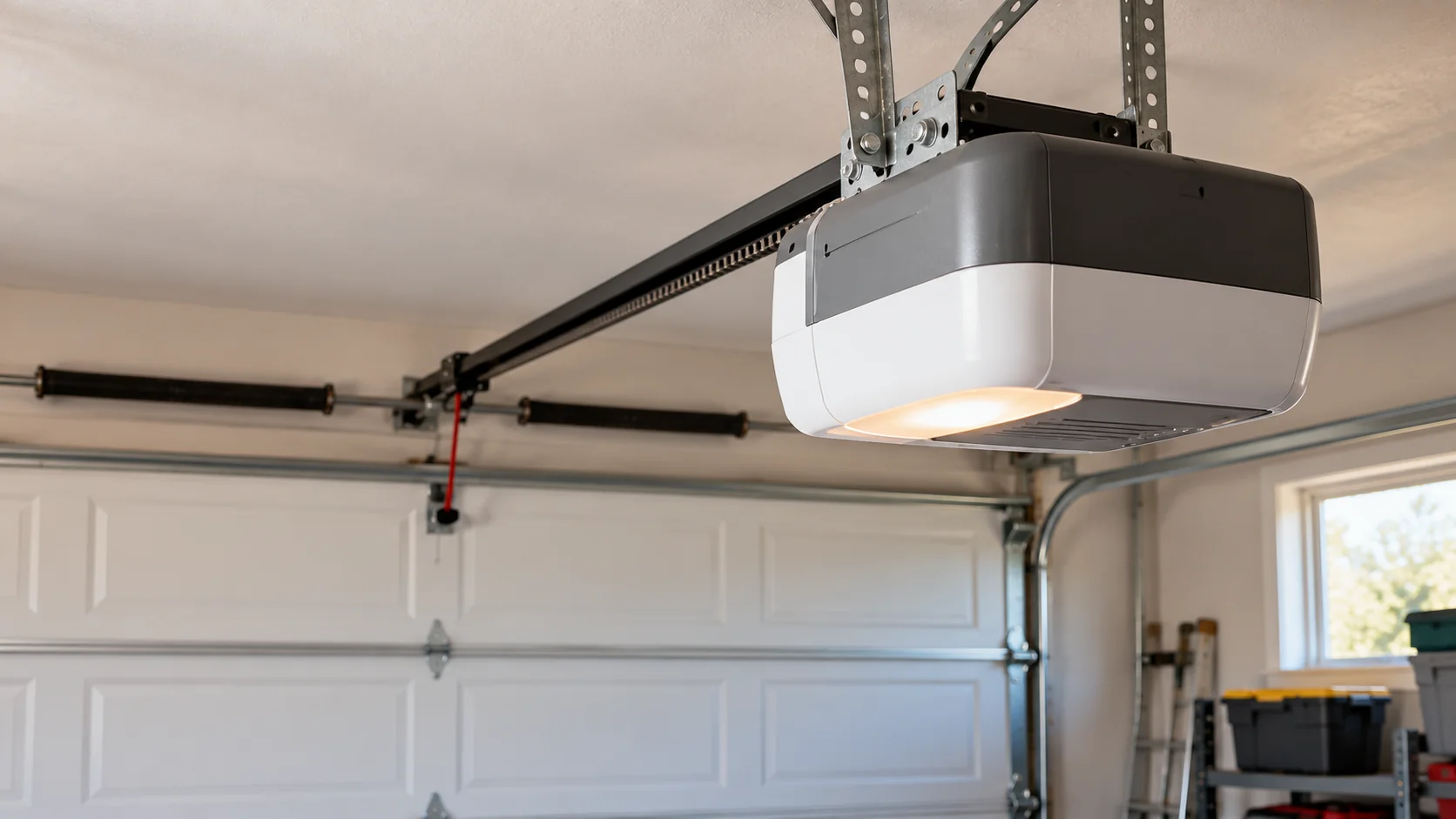
You press the button, the light blinks, and nothing happens. Or the motor runs while the door remains stationary. In a Kingsland home near Lake LBJ, it is tempting to blame heat, humidity or a recent storm, but those observations do not establish the cause. An opener combines electrical controls and mechanical drive components, while the door relies on a separate counterbalance. Several faults can therefore look similar from the driveway. Some checks involve an accessible battery or control setting; others require professional attention because springs and cables store dangerous energy. This guide separates safe observations from technician work and explains what to discuss when comparing repair with replacement. Do not operate a damaged door simply to recreate the fault.
Why Kingsland Openers Take More Abuse Than Most
Door use can be described in complete opening-and-closing cycles, but do not assume every opener has a published cycle-life rating. Check the specific manufacturer's limits and maintenance guidance. Frequent use, long idle periods, door balance and the unit's condition can all affect service needs; the calendar alone does not identify the cause of a fault.
Heat, moisture, dust and electrical faults can affect opener operation. Note when symptoms occur, but do not infer a failed board from lake proximity or weather alone. The technician should check the door, power supply and controls before selecting a repair.
Report symptoms early rather than repeatedly running an unreliable opener.
How an Opener Actually Works, in Plain Terms
The opener moves a door whose weight is assisted by a counterbalance system. It must be matched to the door and installed correctly, but greater motor capacity is not a solution for a failed spring, binding track or damaged cable.
The springs counterbalance the door's weight. Required manual effort depends on the actual system and condition, so there is no universal hand-weight figure that proves a door is sound. A technician checks the mechanical system before deciding whether the opener itself needs repair or replacement.
A counterbalance fault can put additional strain on the opener and damage other components. Replacing the opener without finding that fault may leave the underlying problem unresolved. Any assessment should therefore include the door, tracks, cables and springs as well as the motor unit; our garage door opener service page describes that service.
The rest of the system is straightforward: a motor and gear assembly, a drive mechanism on a rail, a trolley connecting to the door arm, a logic board reading the buttons and remotes, travel and force settings that tell the unit where "open" and "closed" are and how hard to push, and photo-eye safety sensors near the floor that reverse the door if anything breaks the beam.
Chain, Belt, and Screw Drive: What Changes for You
Three drive types cover nearly every residential opener we work on. They differ in noise, cost of ownership, maintenance appetite and how they behave in Texas heat.
| Drive type | Noise level | Best suited to | Heat and dust behavior | Maintenance appetite |
|---|---|---|---|---|
| Chain drive | May transmit more drive noise | Some detached residential garages | Inspect and maintain as specified for the model | Manufacturer-specific lubrication; tension work by technician |
| Belt drive | Often quieter drive operation | Garages near living areas | Temperature limits depend on the model | Inspect according to the manual; do not lubricate the belt |
| Screw drive | Sound varies by design and condition | Doors within the model's listed compatibility | Use the product's temperature and maintenance guidance | Follow the exact manual; service may need a technician |
Wall-mounted jackshaft units also show up in newer builds with high ceilings or storage racks in the way of a center rail. A wall-mount unit lives beside the torsion shaft instead of overhead, which frees the ceiling and tends to be quiet, but it depends even more heavily on a balanced door and correctly sized springs.
We install and service LiftMaster, Chamberlain and Genie openers, and we repair all major opener brands. Which of those three makes sense for a given garage depends less on marketing and more on the door's weight, the ceiling layout, and whether anyone sleeps above the garage.
Reading the Symptoms: A Diagnostic Table
Most opener complaints fall into a handful of patterns. Use this to describe the problem accurately when you call; the more precise you are, the more likely the right part is already on the truck.
| What you see or hear | Likely cause | Homeowner-safe check | Who should fix it |
|---|---|---|---|
| Nothing at all; no light, no sound | No power at the outlet, tripped breaker, unplugged unit, failed transformer | Check breaker and outlet; confirm the unit is plugged in | You, then a technician if power is present |
| Wall button works, remote does not | Dead remote battery, lost programming, failed receiver | Replace the battery; try a second remote | You, then a technician |
| Motor hums but the door does not move | Stripped drive gear, sheared trolley, broken spring, disengaged trolley | Look at the trolley; look at the springs from a distance | Technician |
| Door starts down, then reverses | Misaligned or dirty photo-eyes, obstruction in the path, close-force setting | Clean the lenses; clear the track path; check sensor LEDs | You, then a technician for force settings |
| Door opens a few inches and stops | Broken spring, binding roller, travel limit set wrong | Visually inspect; do not force it | Technician |
| Loud grinding from the motor head | Worn plastic drive gear, dry rail, failing bearing | Listen and note when it happens | Technician |
| Opener runs at random, or lights flash in a pattern | Logic board fault, wiring damage, sensor wire short | Note the blink pattern before calling | Technician |
| Chain or belt sags visibly | Tension has loosened over time | Look, do not adjust | Technician |
Two of those rows deserve emphasis. A motor that hums without moving the door and a door that opens only a few inches are both classic signatures of a broken spring, not a broken opener. Springs store enormous energy and can cause serious injury or worse when they are handled without the right tools and training. Do not put a wrench on them, do not loosen hardware near the torsion shaft, and do not try to take a cable off its drum. Look, listen, note what you saw, and hand it to a technician. Our garage door repair team treats broken springs and doors stuck off track as priority calls for exactly this reason.
Lightning, Surges, and Fried Logic Boards on the Lake
Electrical disturbances can damage connected electronics, but a fault noticed after a storm still needs diagnosis. Openers are unusually exposed: they sit in an unconditioned space, they are connected to house power, and they run long low-voltage wire runs down the walls to the photo-eyes and the wall console. Both supply power and connected wiring may need assessment; symptoms alone do not establish which component failed.
A fault that begins after a storm is worth reporting, but timing does not establish that a logic board is damaged. Power supply, wiring, sensors and mechanical issues can produce similar symptoms. A technician should diagnose the system rather than replace a board based solely on a recent storm or an intermittent remote.
Signs that point toward surge damage rather than mechanical wear:
- The unit worked normally before a specific storm and has been erratic since
- Multiple functions degraded at once, rather than one thing failing cleanly
- Replacing remote batteries and realigning the sensors changes nothing
- A burnt or hot electrical smell near the motor head, or visible damage to accessible exterior electrical components; do not open the housing
- The wall console behaves differently from the remotes with no mechanical explanation
Surge protection on the opener circuit is worth discussing on a lake property. So is the low-voltage wiring: staples driven through the insulation can nick the conductors, a surprisingly common cause of intermittent sensor faults in older Kingsland garages.
Repair or Replace: How We Decide in Kingsland Garages
There is no universal answer, but there is a usable framework. Repair generally makes sense when the unit is relatively recent, the failure is one discrete component, and the door itself is sound. Replacement makes sense when the motor or logic board has failed on an older unit, parts are hard to source, safety features are outdated, or several components are near the end of their service life at once.
Lean toward repair when:
- The opener is not old and has been reliable until now
- The failure is a drive gear, a trolley, a capacitor, a sensor, a remote or a wall console
- The rail, motor and board are all sound
- The door is balanced and the springs are in good shape
Lean toward replacement when:
- The logic board has failed on a unit that is well past its prime
- The motor is drawing hard, running hot, or stalling under normal load
- The unit predates modern photo-eye safety sensors entirely
- Repair costs are stacking toward the cost of a new unit, which we will tell you plainly
- Noise is the real complaint and a suitable belt-drive or wall-mount unit may help after mechanical faults are addressed
- You want current rolling-code security and the old receiver cannot provide it
We give you a written, upfront quote after inspecting the door in person, before any work begins, and the estimate itself is free with no obligation. That inspection is the point at which the repair-versus-replace question actually gets answered, because it is the only way to see the condition of the springs, the rollers, the tracks and the opener together. You can read more about how we work on our about page.
Noise, Remotes, and Connectivity
Quieting an Opener That Runs Under a Bedroom
A very common call from homeowners in Kingsland and nearby Buchanan Dam has nothing to do with a broken opener. The door works; it is just loud enough to wake a child sleeping over the garage at six in the morning.
Noise usually comes from four places, and only one of them is the opener itself:
- Steel rollers with worn bearings, which rumble and clatter along the track
- Loose hinges, brackets and track bolts that rattle in sympathy with the motor
- A chain drive transmitting vibration through the ceiling framing
- The motor head mounted solidly to joists with no vibration isolation
A technician can assess rollers, mounting and hardware before recommending a quieter opener. Do not replace rollers or tighten door hardware yourself: fasteners near the spring system, cables and bottom brackets can carry dangerous loads. On a sound door, use only the homeowner lubrication points identified in its manual. Changes in noise should be diagnosed, not treated as proof that a new motor is necessary.
Connectivity, Keypads, and Remotes
Modern openers from the brands we carry offer smartphone connectivity and integration with home automation in general terms. If that matters to you, say so up front, because adding it later sometimes means a different unit rather than an accessory.
More often the connectivity call is simpler: a remote that stopped working, a keypad that no longer accepts the code, or a car's built-in button that lost its pairing. Those symptoms can have accessory, programming or receiver causes; diagnosis determines the necessary work. Replace the remote battery first. Try a second remote to isolate whether the problem is the remote or the receiver. Check whether the wall console has a lock or vacation mode switch engaged, because lock mode can disable normal remote operation without establishing that the motor has failed.
If the wall console works and no remote does, the receiver or the logic board is the suspect. If nothing works, start with power. If the door moves but reverses, start with the photo-eyes: clean the lenses with a soft cloth, look for a spider web or a wasp nest across the beam, confirm the indicator lights match the normal pattern in the opener manual, and make sure nothing has bumped a bracket out of alignment. Those are all safe, sensible checks that a homeowner can do in five minutes.
What We Do, and What We Do Not Do
Accuracy matters more than a long list, so here is the honest version.
What we do:
- Diagnose and repair openers, including gears, trolleys, rails, sensors, wall consoles, remotes and boards
- Sell and install new openers, including LiftMaster, Chamberlain and Genie
- Service all major garage door opener brands
- Repair the door itself: springs, cables, panels, tracks, rollers
- Install and replace complete garage doors
- Handle residential glass work, including window repair, glass railings and frameless shower doors
What we do not do:
- This guide covers the residential services listed on the site; confirm any other property type directly
- Work outside our posted hours of Monday through Friday, 8am to 5pm
- Quote a price over the phone before anyone has seen the door in person
- Encourage any homeowner to touch a spring, a cable or a drum
You can see the full list on our services overview. Describe any unusual site or installation requirements when you call, and confirm whether the listed service covers them.
Frequently Asked Questions
Why does my garage door opener hum but not move the door?
A hum with no movement almost always means the motor is running while something else is stopping the door. The usual causes are a stripped drive gear, a disconnected trolley, or a broken spring that has left the door far too heavy for the motor to lift. Do not keep pressing the button, because repeated attempts can burn out the motor. Have it inspected.
How long should a garage door opener last in Kingsland?
Service life depends far more on cycles, door balance and electrical events than on the calendar. A unit on a well-balanced door in a household with light traffic lasts a long time. A unit fighting tired springs, running many cycles a day, or absorbing repeated lake-country power surges will age much faster. Keeping the door balanced is the single best thing you can do for opener longevity.
Can I just replace the opener and keep my old garage door?
Often, yes, provided the door is structurally sound, the panels are not damaged, and the springs are correctly sized for the door's weight. A new opener on an unbalanced door can leave a fault unresolved, so the door should be assessed as well as the opener. If the door needs work, we will tell you what it needs and what it would cost in writing before anything is ordered.
My remote works sometimes and my keypad does not. What is wrong?
Intermittent remote behavior with a failing keypad can have several causes, including batteries, programming, interference, wiring or receiver faults. Start by replacing batteries in both, then try reprogramming. If the problem persists or came on after a storm, report the timing to the technician without assuming surge damage or a failed board.
Do you offer same-day opener service around Kingsland?
Most repair calls placed before noon get consideration for same-day service, subject to schedule and parts availability. Broken springs and doors stuck off track are treated as priority calls. Our hours are Monday through Friday, 8am to 5pm, and the fastest way to get on the schedule is a phone call so we can ask the right questions and load the right parts.
Is a belt drive really quieter than a chain drive?
Noticeably, yes. A belt drive removes the metallic chain rattle and transmits less vibration into the ceiling framing, which matters when a bedroom sits over the garage. That said, much of the noise people blame on the opener actually comes from worn steel rollers and loose hardware, so it is worth having both assessed before assuming a new unit is the answer.
Talk to Door Pro Plus About Your Opener
Door Pro Plus serves Kingsland and nearby Hill Country communities from the Marble Falls shop. Describe what happened before the fault began and which controls responded, without repeating a hazardous test. The visit assesses the door and opener together, and the written estimate explains the recommended work and any components required.
Call (830) 385-2449 to describe what your opener is doing. We will ask a few questions, come look at the door and the opener together, and give you a free, no-obligation estimate in writing before any work starts. Review the scope before authorizing work and ask how additional findings would be handled.
Our hours are Monday through Friday, 8am to 5pm, and most repair calls placed before noon get consideration for same-day service, subject to schedule and parts availability. If your door is stuck, off track, or making a noise you have never heard, stop using the opener and call (830) 385-2449 before the damage gets worse.
Need garage door or glass service?
Door Pro Plus serves Marble Falls, Horseshoe Bay, Burnet, Llano, Kingsland, and the Texas Hill Country. Call 830-385-2449 for a free estimate.