
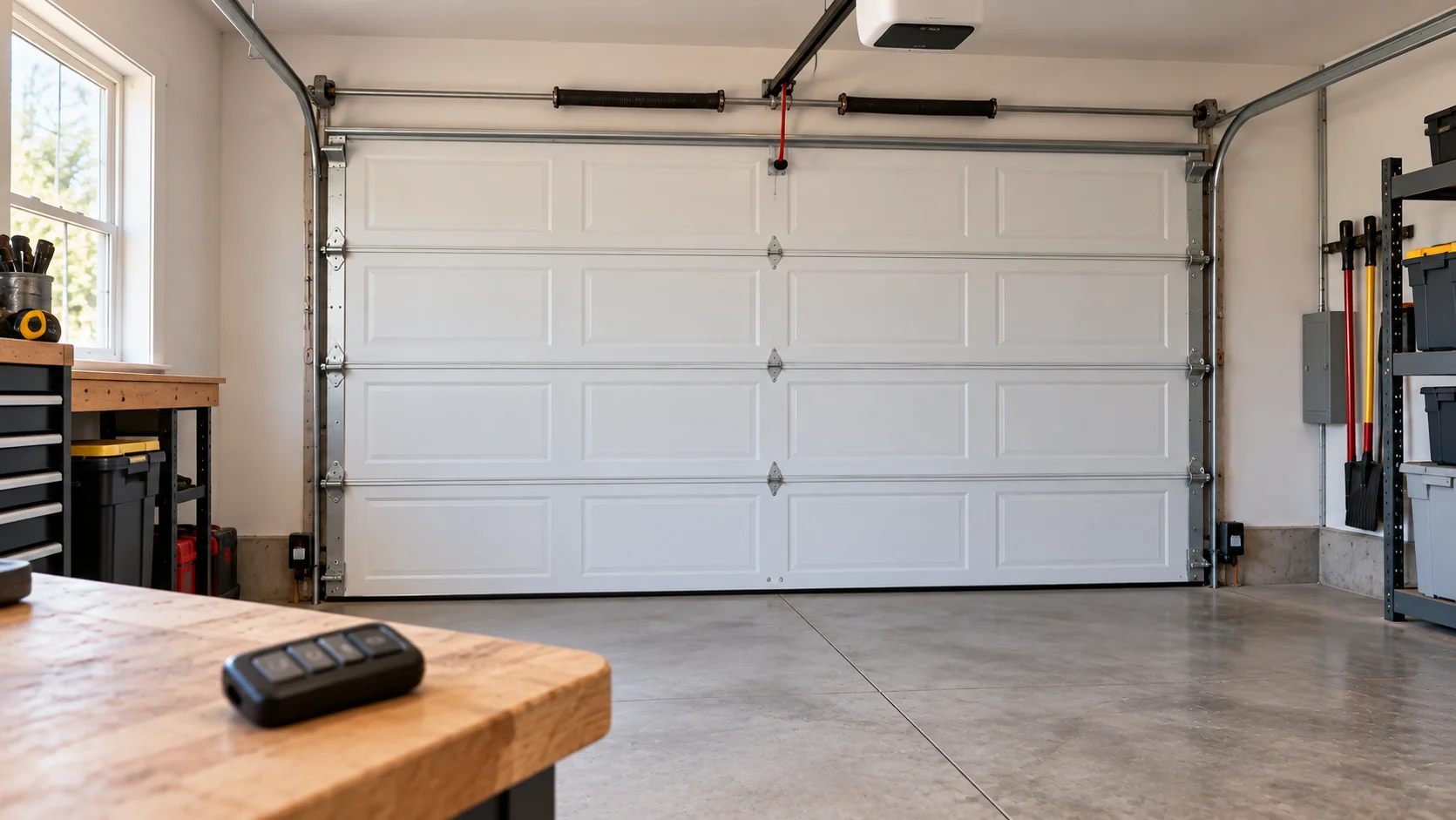
You hit the button and nothing happens. Or the door starts down, stops halfway, and rolls right back up. Or it opens six inches, thinks about it, and quits. A garage door that will not open or close can have several explanations in a Burnet home, including a dead remote battery, a nudged safety sensor, or a lock button somebody pressed by accident. Other faults can involve springs, cables, and other components that store enough energy to cause serious injury. This guide walks the whole decision tree in order, from the checks anyone can safely run to the point where the right move is to step back and pick up the phone. Describe only what you already noticed, without repeating a risky operation to prove it.
Start Here: What Is the Door Actually Doing?
Before touching anything, watch the door and note exactly which of these describes it. The symptom narrows the cause faster than anything else.
- Nothing at all. No motor sound, no light, no movement.
- The opener light blinks, but the door does not move.
- The motor hums or runs, and the door stays put.
- The door starts to close, then reverses and goes back up.
- The door opens partway and stops.
- The door moves but grinds, shudders, or bangs.
- The wall button works but the remote does not, or the reverse.
- The door came off its tracks or looks crooked in the opening.
Write down what happened just before it started. A storm rolled through, a vehicle bumped the track, somebody backed out while it was still coming up, or a cold night after weeks of heat. That context routinely points straight to the cause.
Also note whether this is new or gradual. A door that has been getting noisier and slower for a month is telling a different story from one that worked yesterday and did nothing this morning.
Limited Homeowner Checks for a Sound Door
These are limited, low-risk checks only when the door is fully closed, appears undamaged and has shown no warning of a broken spring, loose cable or off-track condition. If damage is suspected, stop operating it and do not use the release cord. Keep clear of the travel path and do not climb on furniture to reach the opener.
1. Confirm the opener has power
From a safe position, note whether the opener has power. Only check an accessible plug or ordinary breaker if you can do so without climbing, contacting damaged wiring or entering the door's path. Do not repeatedly reset a tripping breaker. Burning smells, heat damage or exposed wires require professional assessment rather than further troubleshooting.
2. Try the wall button and the remote separately
This one test splits the problem in half. If the wall button works and the remote does not, the fault is in the remote or its programming, not in the door. If neither works, the fault is in the opener or the door itself.
3. Replace the remote battery and check the keypad
Remote batteries die quietly, often losing range before they lose function entirely, so the remote works from ten feet but not from the street. Swap in a fresh battery. Exterior keypads take the worst of it on a January morning; cold drains those batteries fast and moisture gets into the housing. If a fresh battery does not fix it, the remote may need reprogramming to the opener.
4. Check for lock mode
Most wall consoles have a lock or vacation button. When it is engaged, the opener ignores every remote, and many units respond with a blinking light. It is pressed by accident more often than anyone would guess, often by a kid or while cleaning. Press and hold it to toggle it off.
5. Inspect the photo-eyes
Two small sensors sit near the floor on either side of the opening, roughly six inches up, and they must see each other for the door to close. A blocked or misaligned beam is one possible explanation when a door opens but refuses to close.
- Look for indicator lights. Typically their indicators should match the normal pattern in the model's manual. A blinking or dark light means they are not aligned or not powered.
- Wipe both lenses with a dry cloth. Dust, cobwebs, and grime block the beam. Spiders love these brackets.
- Check alignment. A bumped bracket throws the beam off by a fraction of an inch and that is enough.
- Clear the path. A trash can, a bag of mulch, a bicycle, or a broom leaning across the beam will do it.
- Watch for low sun. Direct sunlight into a lens at certain times of day can overwhelm the sensor.
6. Look for an obstruction in the path
Walk the full width of the opening and run your eye down both tracks. Gravel, a stray bolt, a chunk of caliche off a county road, hardened debris, or ice in the bottom channel can all stop a door. Sweep the tracks clean. Do not bend, hammer, or adjust the track itself.
7. Check whether the door is on manual release
A disconnected trolley is one possible explanation for a running motor and stationary door. Note its visible position without operating the door or pulling the cord. A faulty counterbalance can produce similar symptoms. If you are unsure why it was disconnected, leave re-engagement and any movement test to the technician.
8. Lubricate and observe
On a sound, fully closed door, follow its manufacturer's instructions for any homeowner lubrication points. Keep hands away from hinges and pinch points, and leave bearings near the spring system and all loaded components to the technician. Lubrication is not a remedy for a crooked, heavy, damaged or binding door.
If the door works after these steps, good. If it does not, the next section helps you describe the problem accurately over the phone.
A Symptom-to-Cause Chart for Burnet Garage Doors
| What you see | Most likely causes | Safe to check yourself | Technician work |
|---|---|---|---|
| Nothing at all, no lights | Unplugged, tripped breaker, failed logic board | Plug and breaker | Board diagnosis and replacement |
| Remote dead, wall button fine | Battery, programming, receiver | Battery, reprogram attempt | Receiver and antenna repair |
| Opener runs, door still | Emergency release pulled, stripped gear, broken trolley | Confirm release position | Gear, trolley, and carriage repair |
| Closes partway, reverses up | Photo-eye blocked or misaligned, obstruction, close-force setting | Lenses, alignment, debris | Force and limit adjustment |
| Opens a few inches, stops | Broken spring, jammed track, open-limit setting | Look only, do not lift | Spring and track repair |
| Motor hums, no movement | Broken spring, seized rollers, failed capacitor | Look and listen only | Spring, roller, motor repair |
| Loud bang, then too heavy | Broken torsion or extension spring | Nothing, keep it closed | Priority spring replacement |
| Door crooked or off track | Broken cable, worn roller, bent track, impact | Stop using it entirely | Off-track correction, priority |
| Grinding or shuddering | Dry or worn rollers, loose hardware, bent track | Lubricate rollers and hinges | Roller, track, and hardware repair |
| Slams shut fast | Broken spring or failed cable | Nothing, keep clear | Priority spring and cable repair |
Anything in the bottom half of that chart means stop using the opener. Running a door with a broken spring or a jumped cable turns one repair into several, and it is how people get hurt.
When the Motor Runs but the Door Does Not Move
This is a distinctive symptom and worth its own explanation, because homeowners often assume the opener died when it is working fine.
The trolley is disconnected. An earlier manual release may have separated the door from its carriage. Report what already happened and what you can see; do not pull the cord or repeat the operation to diagnose it.
The drive gear is stripped. In many chain-drive openers a plastic gear meshes with the worm drive. Run it against a heavy or binding door often enough and the teeth shear. You will typically hear a grinding whir with no chain movement. That is a repair, not a replacement of the whole unit, in most cases.
A spring has broken. This is the one that matters. The opener is sized to move a counterbalanced door, not to lift the door's full weight. With a broken spring the motor strains, hums, clicks, and gives up, or it lifts a few inches and stops. Keep running it and you will strip the gear, bend the rail, or burn out the board, adding an opener repair to a spring repair.
The capacitor or motor has failed. A hum with no rotation can be a failed starting capacitor. That is inside the housing and it is technician work.
Openers are one of our core services. We repair and install all major brands, including LiftMaster, Chamberlain, and Genie, and you can read more on our garage door opener service page.
Broken Spring or Opener Fault?
Telling these apart before you call saves time, because it changes what a technician brings.
Look up at the springs from a safe distance, with your hands at your sides.
Possible spring or cable fault: a visible spring separation, slack cable, crooked door or the symptoms of a sudden heavy load needs professional attention. You can report these observations without touching the mechanism. Do not repeat an operation that already produced a bang, partial lift or uneven movement.
Possible opener fault: no power, a battery issue or an error indicator can help narrow troubleshooting, but neither an indicator light nor an apparently intact spring proves that the mechanical system is sound.
Do not test balance to decide between them. A technician can secure the door, inspect the counterbalance and perform the appropriate tests. Pulling the release and lifting a suspect door can create a fall hazard. Leave a closed door closed; if it is stuck open, keep everyone clear and do not try to bring it down yourself.
Spring work is covered on our garage door spring repair page, and broken springs are treated as priority calls.
Where the Line Is: What Only a Technician Should Touch
We want homeowners to diagnose confidently. We also want to be blunt about where diagnosis stops. Garage door springs and cables store enough energy to break bones and worse.
Never touch, adjust, loosen, or remove:
- Springs. Torsion or extension, broken or intact. A spring that looks broken can still hold tension.
- Winding bars, cones, and set screws. Loosening a set screw releases the shaft. This is the most dangerous step in the trade and it requires the right tools and real training.
- Cables and drums. A slack cable is still attached to a door under load. Unwrapping one can drop the door instantly.
- The torsion shaft, bearing plates, or center bracket.
- A door that is off track. Do not lever, pry, or force it back. It can fall.
- A bent or damaged panel, or the bottom bracket. The bottom bracket is under cable tension at all times.
- Travel limit and force settings. Set wrong, these defeat the auto-reverse safety feature that protects children and pets.
- Anything inside the opener housing. Boards, capacitors, and wiring.
If the door is stuck open and you cannot safely close it, keep people, pets, and vehicles clear of the opening and call from outside. If it is stuck closed, leave it closed and park in the driveway. Neither situation improves by forcing it.
What a Repair Visit Looks Like in Burnet
Burnet sits north of us on US-281, an easy run from our Marble Falls shop, and it is one of the areas we cover routinely. Coverage details are on our Burnet service area page, and the full regional list is on our service areas page.
Here is how a call typically goes:
- You call and describe the symptom. Use the language from the chart above. The more precise you are, the better stocked the truck is when it arrives.
- We schedule. Our hours are Monday through Friday, 8am to 5pm. Most repair calls placed before noon get consideration for same-day service, subject to schedule and parts availability. Broken springs and off-track doors are treated as priority calls.
- We diagnose in person. Springs, cables, drums, rollers, hinges, tracks, the opener and its wiring, the photo-eyes, and the door balance all get checked, because a door is one system and the visible symptom is not always the root cause.
- You get a written, upfront quote before work starts. Estimates are free and no-obligation, the full price is in writing. Any additional work should be discussed before approval.
- We do the work and test it with you. Ask how balance, travel, contact reversal and photo-eye function will be checked before returning the system to service. Repair timing depends on the diagnosis and availability of the correct parts.
We handle the full range of garage door repair on homes, using name-brand parts and quality glass rather than budget imports. For a service visit, our customer reviews let you read homeowners' accounts of their service experiences. To get on the schedule, call (830) 385-2449.
Frequently Asked Questions
Why does my garage door open but not close?
A blocked or misaligned photo-eye beam is one possible cause. The opener is designed to refuse to close if the beam between them is broken. Check that both lenses are clean, that the indicator lights are steady rather than blinking, that the brackets have not been bumped out of alignment, and that nothing is sitting in the beam's path near the floor.
My garage door reverses right before it touches the ground. What is wrong?
Usually either an obstruction the door is contacting, such as debris or ice in the bottom channel, or a close-force and travel-limit setting that no longer matches the door. Sweep the channel and the tracks first. If it still reverses, the limit and force settings need adjustment, and those should be set by a technician because they directly control the auto-reverse safety function.
Is it safe to use my garage door in Burnet if it makes a loud bang and now feels heavy?
No. A loud bang followed by a door that is suddenly heavy almost always means a broken spring. Leave the door closed, stop using the opener, and park outside if a vehicle is trapped. The door carries its full weight now and slack cables can jump their drums and let it drop. Broken springs are priority calls for us.
Can I fix a garage door that came off its track myself?
Please do not. An off-track door is held by cables still under tension, and levering it can drop several hundred pounds of steel or release a cable violently. Stop using the opener immediately, keep people and pets away from the opening, and call. We treat off-track doors as priority calls precisely because they are unstable until they are corrected.
How quickly can someone come out to Burnet?
Our hours are Monday through Friday, 8am to 5pm. Most repair calls placed before noon get consideration for same-day service, subject to schedule and parts availability, and broken springs and off-track doors get priority handling. Calling early in the day gives you the best chance at a same-day visit, and repair timing depends on the diagnosis and availability of the correct parts.
Should I repair my opener or replace it?
It depends on the failure and the unit's age. Stripped drive gears, worn trolleys, bad sensors, and damaged wiring are typically repairs. A failed logic board in an older unit, a burned-out motor, or a model missing modern safety reversal features often makes replacement the better value. We diagnose in person and give you both options in writing before starting.
Call Door Pro Plus in Burnet
Work through the safe checks. If the door is running again after a battery, a lens wipe, or a swept track, that was a good afternoon. If it is not, or if you saw a gap in a spring, a slack cable, or a door sitting crooked in its opening, stop there and let a technician take it from that point.
Call Door Pro Plus at (830) 385-2449, Monday through Friday, 8am to 5pm. Describe what the door is doing in the words you used above, so the technician can plan the assessment; compatible parts still need to be confirmed. Estimates are free and no-obligation, pricing goes in writing after we inspect the door in person, and broken springs and off-track doors are identified as priority calls on the live site. Completion timing depends on the diagnosis and required parts, and availability is confirmed when you call during business hours.
Need garage door or glass service?
Door Pro Plus serves Marble Falls, Horseshoe Bay, Burnet, Llano, Kingsland, and the Texas Hill Country. Call 830-385-2449 for a free estimate.